
Tour the Historic Greenwood Cemetery
Join us for one of our three captivating cemetery tours and discover the rich history and stories that make Greenwood Cemetery a truly special place.
Walking Tour
The city cemetery.
The original map of the City of Jackson was completed in 1822, and the General Assembly authorized state officials to establish a place for a cemetery in January 1823. The original "old graveyard" was comprised of 6 acres but grew to about 23 acres in the mid-19th century, with the addition of the "new cemetery" lots. It was known then as the "city cemetery."
Final resting place.
In Greenwood Cemetery rest 8 Mississippi governors, 14 Jackson mayors, many clergymen, physicians, dentists, nurses, midwives, lawyers, judges, state officials, teachers, businesspeople, soldiers, paupers, husbands, wives, and children. A walk through the cemetery is a stroll through history, all enhanced by funerary sculpture and the natural beauty of trees and flowers, especially the impressive collection of antique roses. The cemetery is listed on the National Register of Historic Places and is a Mississippi Landmark.
For all city residents.
Every resident of Jackson, black or white, and regardless of religion or social standing, was entitled to purchase a lot in the city cemetery. Unfortunately, most official records of burials have vanished. Newspaper accounts have been one of the most valuable sources of information about persons buried in the cemetery. More than 5,000 names and dates, from both marked and unmarked graves, have been recorded on www.findagrave.com, together with many burial location details."
Other city cemeteries.
By the 1890s, the population of the capital city had outgrown the cemetery. Cedarlawn Cemetery was established in west Jackson and designated for white burials only. Elmwood Cemetery and Mt. Olive Cemetery (originally a private cemetery) were established in west Jackson for black citizens. The Jewish Cemetery on North State Street had been established in the 1860s.
New name.
It was the Ladies Auxiliary Cemetery Association that submitted the name "Greenwood Cemetery" to city leaders in 1899, and the name was adopted in 1900. In 1909, the city declared Greenwood Cemetery "full" and stopped selling plots. Burials of both black and white persons continue to this day, however, for those who have family plots. Various iterations of the cemetery association have continued to be involved throughout the 20th and 21st centuries.
-
Arnold Smith has a tree stump monument, of which there are many examples in the cemetery, the stump and cut-off limbs symbolizing a life cut short. His is adorned with a lily, symbol of resurrection, and the Masonic square and compass emblem. Sec. 7, Lot 23.
-
This early immigrant from Alsace, France, married Elizabeth Nahrgang (1825-1904), native of Germany. He operated several businesses at the corner of Capitol and State Streets known as Spengler's Corner, first established by older brother Joseph Spengler who died in the yellow fever epidemic of 1853 and is buried in Section 5. The large family fills the beautiful lot around the elders' tall, cross-topped obelisk. Sec. 2, Lot 72.
-
The acclaimed Pulitzer Prize-winning author was born a few blocks from the cemetery on North Congress Street. The family later moved to 1119 Pinehurst Place, now a museum open to the public. Ms. Welty rests beside her brother Christian who died as an infant before she was born. Sec. 2, Lot 68.
-
Pioneer journalist who cofounded the Jackson Clarion-Ledger and owned it for 50 years. He and his wife Ida Henry (1852-1928) and daughter Marie Willie Henry (1879-1941) are entombed in a classically inspired stone vault. Sec. 2, Lots 91-92.
-
Her husband Cornelius "Con" Sheehan (died 1893), a railroad conductor and real estate developer, erected the large monument and statue of a woman standing by a rustic cross. Both Sheehans were born in Ireland. Sec. 2, Lot 97.
-
A Republican, John McGill was mayor of Jackson from 1874-88. For 20 years, he was foreman of the Gem Fire Company No. 2, which volunteer body erected his rusticated monument. Mayor McGill rests beside his wife Mary Kerr McGill (1838-66) in the lot enclosed by an iron fence. Sec. 2, Lot 106..
-
Fitzhugh (1841-1904)Methodist Bishop W. B. Murrah was the first president of Millsaps College from 1890- 1910, and Dr. Lewis T. Fitzhugh was the founder and president of Belhaven College from 1894-1904. Rev. Murrah married Beulah Fitzhugh (1864-1951), Dr. Fitzhugh's daughter. Sec. 3, Lot 77.
-
Physician and druggist, Dr. Hunter was a founder of the Mississippi Baptist Hospital. He was son of the Rev. Dr. John Hunter, Presbyterian minister. He is buried with his two wives in a lot graced by two large camellias. Sec. 3, Lot 50.
-
A prominent businessman and dairy farmer, Mr. Odeneal and his wife Anna Helm Odeneal (1845-1923) are buried in a massive stone vault erected in 1903. Sec. 3, Lot 70.
-
Elected Mississippi Secretary of State in 1869, he was the first African American elected to a major state office. He was a Methodist Episcopal missionary and minister. His unique monument bears his sculpted portrait. Sec. 4, Lot 4.
-
A magnificent angel graces the burial plots for attorney Preston Hay (1806- 98) and his daughters Mary Preston Hay Lester (1841-90) and Ellen Hay Moore (1829-90), who gave Poindexter Park to the city of Jackson, and other family members. The angel is cover photo for this brochure. Sec. 4, Lot 9-11.
-
A Virginian by birth, he practiced law in Kentucky, then moved to Mississippi to begin a long history of public service as state attorney general, U. S. Attorney, and U. S. District Court Judge. He had eleven children, of which two were celebrated generals in the Civil War and are buried in this cemetery, along with other descendants. Sec 4, Lot 43.
-
They and some of their children occupy a brick and stone vault topped by a statue of a kneeling woman. Mr. Helm was a prosperous banker. In 1868, the Helms, who were devout Presbyterians, gave money and land at the corner of Lamar and Church Streets to establish the first church for African Americans in Jackson. It became the Mt. Helm Baptist Church, today located a block from the cemetery at Church and Dreyfus Streets. Sec. 5, Lot 20.
-
Native of Ireland, he was pastor of the First Presbyterian Church in Jackson from 1858 until 1897. Within the same burial plot, and enclosed by an ornate iron fence, are monuments for his wife Rosa Hunter (1824-1905), her parents and first husband, and various descendants. Sec. 5, Lot 22..
-
This structure, built in the 1870s, has had many uses through the years – a shady resting place, meeting place, sexton's office, and storage for grass-cutting equipment. Sec. 5, Lots 72-73.
-
The white-painted brick vault was built for Dr. Redmond, a successful African American businessman, physician, druggist, and then lawyer, who resided on nearby Church Street. Also in the vault are his first and second wives Ida Revels Redmond (1873-1914) and Johnnie King Redmond (1887-1958), brother Andrew J. Redmond (1880- 1946), and daughter Linnie Naomi Redmond (1921-26). Another brother, Augustus M. Redmond (1876-1951), pharmacist, is buried in a brick vault in the Old Cemetery, Section 4. Old Cem., Sec. 2.
-
58th governor of Mississippi, beside his wife Elise Varner Winter (1926-2021). Throughout his career, he was a proponent of a sound education system and an ardent supporter of Civil Rights and racial equality. Old Cem., Sec. 2.
-
A South Carolina native and 7th Mississippi governor, he served from 1832 until his death in 1833 in a cholera epidemic. During his term as governor, the legislature appropriated funds for building the state capitol (now Old Capitol Museum) and governor's mansion. His grave marker is the oldest extant monument in the cemetery. Old Cem., Sec. 3.
-
Her grave is guarded by a large sculpted angel and cross. Born about 1854, she was the wife of Alex Ross, a teamster/drayman. They were African Americans born in Virginia. They had twelve children, most of whom moved north to St. Louis or Chicago. Her husband's burial location is unknown. Old Cem., Sec. 3.
-
He was a merchant. Several members of the German Hilzheim family were influential in Jackson's business community in the 1840s-50s. The family plot is distinguished by a Gothic arched entrance. Old Cem., Sec 3.
Notable Sites

-
This black child died at age six during the yellow fever epidemic of 1878. A heartbreaking number of infants and children are buried in the cemetery. Old Cem., Sec. 4.
-
Once a temporary storage for caskets awaiting permanent interment. Hiram K. Hardy started the undertaking business in 1890, and he and his wife and son ran the company at the corner of President and Pascagoula Streets until 1929. Old Cem., Sec. 4.
-
Most of the markers say "Unknown Soldier" for those soldiers who died in and near Jackson during the Civil War. Their names are known but not the location of their graves. There are more than 1,200 Confederate soldiers in the cemetery; some who survived combat are in private lots. Old Cem., Sec. 1.
-
Natives of Ireland, they lie beneath a double marker topped with a life-size marble statue of a woman in repose, holding a floral wreath. Mr. Lemon was a successful merchant and philanthropist in Jackson. Old Cem., Sec. 1.
-
A cotton planter and industrialist who was owner of Mississippi Mills, a cotton and wool textile complex in Wesson. He was a generous benefactor to the cemetery, and his monument, carved in Italy, is the tallest in the cemetery. Sec. 6, Lot 64.
-
Dr. Kells was a medical doctor who served as Superintendent of the State Lunatic Asylum. Dr. Kells' elaborately decorated marker is a larger version of his wife's, and the lot is enclosed by a decorative iron fence, as many once were. Sec. 6, Lot 68.
-
Native of England, he came to Jackson to establish a female academy. He was rector of St. Andrew's Episcopal Church in 1846-47 and served as chaplain of the State Penitentiary which was near the cemetery in his time. He died in the yellow fever epidemic of 1853, and church members erected the Gothic-inspired monument in the Central Avenue Circle as a cenotaph to his memory.
-
A sculpted stone angel adorns the grave of "Auntie" Martha Lee Robinson (1864-1907), which is adjacent to a tall obelisk erected for her parents. Her father John W. Robinson (1823-81) was a prominent Jackson businessman. He built the Edwards House across from Union Depot and established the first muledrawn street railway on Capitol Street from
-
Legend has it that the dog faithfully attended his young mistress's grave until his own death. Mamie is also buried in the same lot with her mother, Annie Tarpley Simms (1832-1913) and her grandfather, attorney Collin S. Tarpley (1802-60) who served on the Mississippi Supreme Court. Sec. 1, Lot 46.
-
Grandfather and grandson were both Episcopal bishops. The Lord's Supper on the younger bishop's monument was carved in Italy. Sec. 1, Lots 19 & 20.
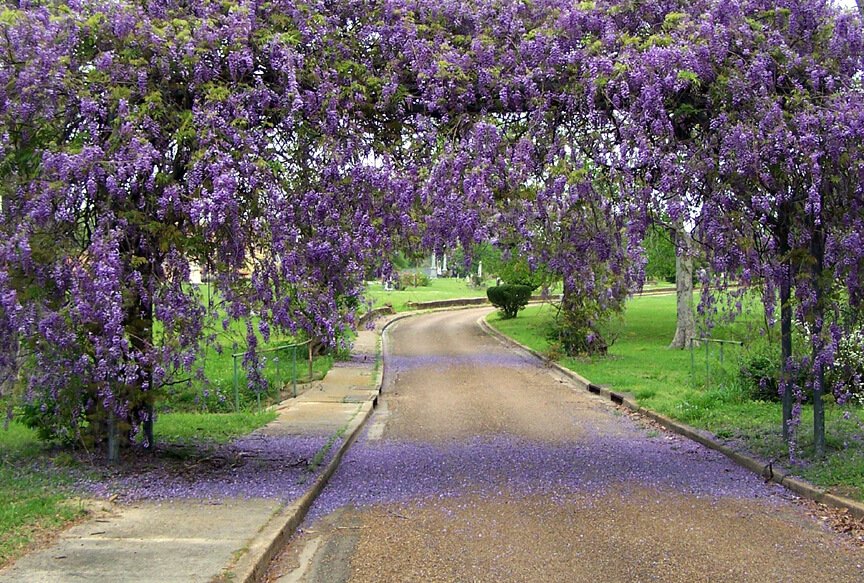
"I'm one of those people who can't not read every tombstone
— they scream at me for their names to be heard."
– Natasha Tretheway
Many visitors to the cemetery may be surprised at the number of black Mississippians interred at Greenwood, but given the complex history of the region and of race relations in Mississippi, that surprise may soon give way to a deeper consideration of the commonalities of our human condition. This walking tour deepens our understanding of Jackson's history by revealing what such tours usually gloss over: the rich tapestry of human achievement beyond the usual luminaries. Interred in the cemetery are laborers, businessmen and women, housewives, farmers, bakers, midwives, teachers, and former slaves.
Taken together, these representative lives help us to imagine a more vibrant community history; considered alongside their white counterparts, we may begin to wonder at the false divisions crafted by political and social policy which kept apart in life those who lie side by side in death. For example, census data reveals shifting legal classifications as the nation sought to define what it meant to be "white" and "not-white"; Benjamin F. Hardy, Alabama native and buried here at Greenwood, went from a classification of "white" to "black" in a matter of three federal census takings.
As is always the case, the scant information on display in a cemetery surfaces more questions upon contemplation than answers. We invite and encourage you to follow whatever paths of inquiry your tour may suggest to you.
-
Reverend Marion Dunbar, a Georgia native, was a deacon for the black slaves who were allowed to hold services in the basement of the First Baptist Church and the first pastor at Mt. Helm Baptist Church, the first church for African Americans in Jackson. Dunbar is also listed as a blacksmith in the 1870 census. His wife, Lydia, was a native of South Carolina.
-
The Bankses were the proprietors of Peoples Funeral Home (est. 1925) located on Farish Street, where their son, Earle W. Banks Jr, later worked as an undertaker. Mrs. Banks was a lifelong resident of Jackson. She attended Holy Ghost Catholic School, the first black Catholic school in Jackson, and graduated valedictorian of her class. She went on to attend Tougaloo College and married in 1926. After her husband's death in 1985, Mrs. Banks became part owner of the funeral home and was an avid seamstress, gardener, and writer until she died of heart failure in 1998 at the age of 93.
-
Archie B. Hopkins and her daughters Lula Mae and Albertine (Mason) lived with Archie's mother Irene Reid (1872-1947) and Irene's husband Moses Reid. Archie taught at Mary C. Jones School. Both daughters became teachers. Lula Mae married Lucius Patton, who was also a school teacher. She taught at Smith Robertson School and E. A. Ware School. Albertine Mason taught at Lanier and Murrah High Schools.
-
Benjamin F. Hardy—Benjamin Hardy was a native of Alabama. In 1860, he was listed among free white inhabitants with no special designation. On the 1870 census he was listed as white with a black wife, Ellen, and several black children. In 1870 Benjamin became a printer. On the 1880 census he was listed as black, working on a farm. Benjamin died at the age of 56 in 1886.
-
Born in Virginia, Susan Ross was married to Alex, a teamster/drayman. They had twelve children, nine living by the time of the 1900 census. Three of those children would eventually teach in the public schools and remained in the family home.
-
Illustrative of the difficulty in relying on census and directory data, the 1900 census lists Charles Morgan (1845-1902) as a janitor living with his wife Carrie Morgan and their family on Congress Street. In the 1901 City Directory, he is listed as a porter at the post office and living on West Street.
-
Lizzie Rogers was married to Robert Rogers, a drayman. She died at age thirty-eight of tuberculosis.
-
Mary Jane Miner/Minor, widowed by 1900, was an employee of the state Insane Hospital.
-
Lydia Franklin was a native of South Carolina. She was of mixed race and worked as a seamstress. She lived with her husband Arnold, a house servant, in Canton, MS.
-
Mary Wallington worked as a washwoman and was married to Henry, a truck farmer. While they lived in Beat 5, not the city of Jackson, she is interred here at Greenwood.
-
Harry was a porter and cotton sampler for W. J. Davis & Co. Bettie was a teacher at Smith Robertson School.
-
Jennie V. Grayson was a single woman of mixed race born in Mississippi. Jennie lived with her brother William and worked as a dressmaker and seamstress.
-
Albert Lee Johnson and his brother, Pinckney J. Johnson, were Mississippi natives. Albert Johnson's monument bears the insignia of GUOOF Lodge 1927. He is buried next to his brother Pinckney.
-
Virgil Ruffin Sr. was a day laborer at Taylor's Brickyard. He and his wife, Sallie, had twelve children. Ten of them were living by the 1900 census.
-
Catherine "Kate" Williams was born a slave. After emancipation, she continued to work for the Winter family and is buried in their family plot.
-
The Redmond Family is buried in a shared vault. Interred here are Dr. Sidney D. Redmond, physician, pharmacist, businessman, and lawyer; his brother, Andrew J. Redmond; his first wife, Ida Revels Redmond; his second wife, Johnnie King Redmond; and his daughter with his second wife, Linnie Naomi Redmond.
-
Professor Samuel Manuel Brinkley was an educator who served as teaching principal of Hill School, the first organized junior high school program for African American students in Jackson Public Schools. Brinkley Middle School is named in his honor. His wife is believed to be buried next to him.
-
Laura Ferguson was born in Madison County in 1845. She was married to George Ferguson, a drayman. Daisy, her daughter from a former marriage lived with them and was a music teacher.
-
Susan Jones ("Our Mammy Sue") was a freed slave who remained with the family for whom she worked until her death. She is interred in the family plot.
-
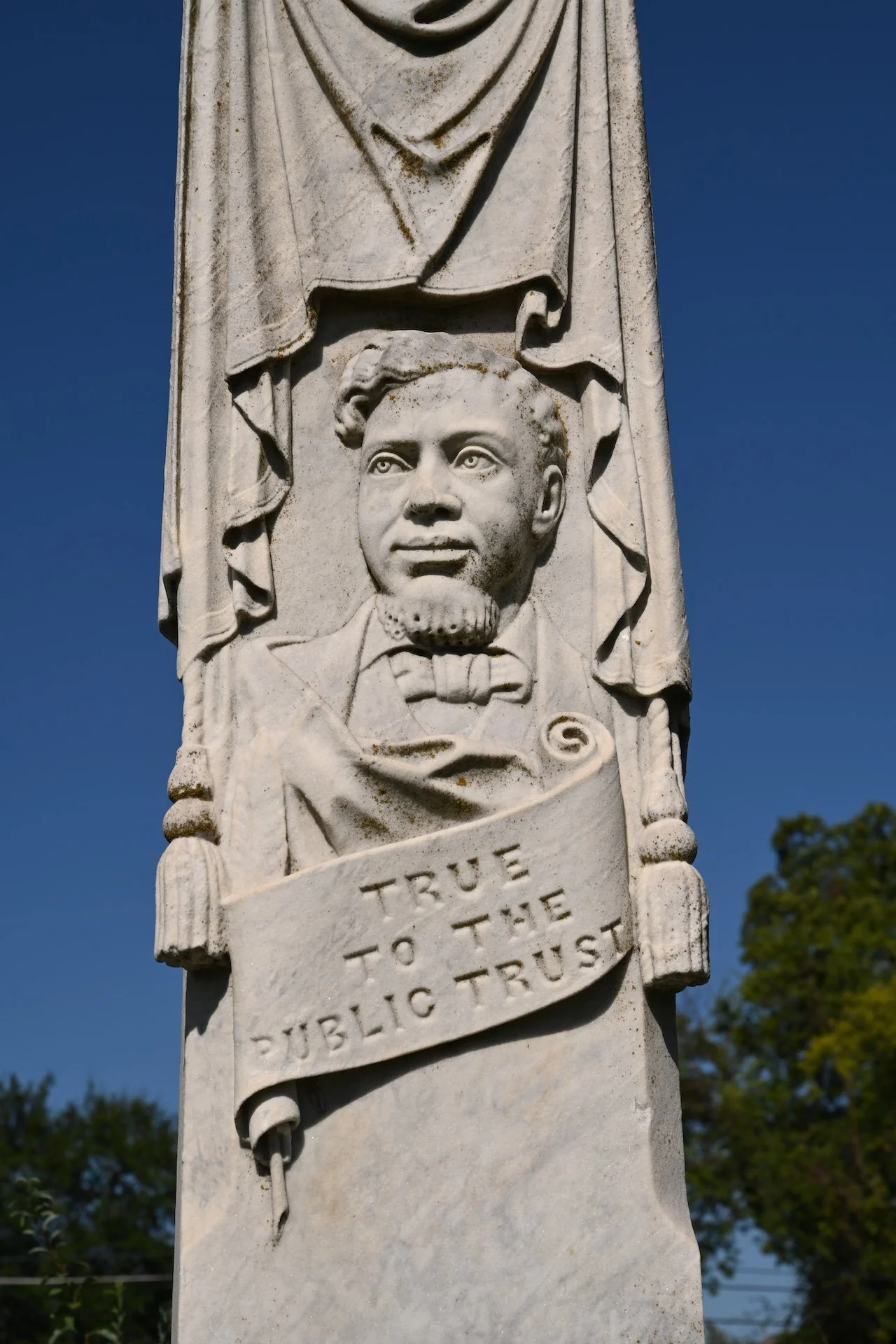
Secretary of State James D. Lynch was born to free black parents in 1839. He graduated from Kimball Academy in New Hampshire at the age of 18. He was unable to continue his education due to the failure of his father's business, so he became a teacher and minister in the AME Church. In 1867, he connected with the Methodist Episcopal Church and relocated to Mississippi. 1n 1869 he was elected to the office of Secretary of State by a large margin; his term was cut short by his death in December of that year due to a chronic lung illness.
Notable Sites
-
John Moore and Martha Webb Moore were both born in Mississippi. John Moore was a carpenter, and Martha Moore was a cook. John's monument is marked by the Grand United Order of Odd Fellows, and Martha's monument is marked by the Household of Ruth, the female counterpart to the GUOOF. Social organizations like the Grand United Order of Odd Fellows were formed to counter the prohibition of black members in white organizations like the Independent Order of Odd Fellows.
-
Isaac Washington's marker also bears the insignia of the GUOOF Lodge 8722. He worked as a fish peddler and died of an internal injury at the age of seventy-eight. He is buried in a lot with Phillis Johnson and her daughter Julia Johnson Jones. Phillis Johnson was born in 1856 in Mississippi On the 1900 census, Phillis was listed as a widow and was the head of the household, working as a laundrywoman and living in a rented house on Monument Street. While Phillis could neither read nor write, all four of her children, Rosa, Fannie, Joseph, and Julia, were able to do so.
-
Henry V. Thomas and Fannie C. Thomas owned a florist shop, where they both worked.
-
William Henry Lanier was the first Superintendent of Jackson Colored Schools. He was born a slave in Huntsville, AL. He studied at Tougaloo, Oberlin, and Fisk Colleges and received a B.A. from Roger Williams University. He served as President of Alcorn College for six years and was the Principal of Robertson School from 1912-1929. Lanier High School is so named in his memory.
-
Junius A Tharp was a bricklayer. His wife, Olivia, was a nurse. They had three children: Doris, Catherine, and Sidney. Sidney R. Tharp went on to become a lawyer with offices on N. Farish Street.
-
Evangeline Byrd, was a well-known and highly respected midwife. A widow according to the 1920 census, she lived with her son William and daughter Ola at her home on Church Street. Augustus M. Redmond, pharmacist at Redmond Drug Store on Farish Street is entombed in the brick vault south of Evangeline.
-
Sarah "Sallie" Campbell Dawson—Sarah Dawson was born in Missouri in 1846 and was a teacher at Smith Robertson School in Jackson. She was married to William Dawson, a plasterer. She is buried in this plot with her granddaughters, Ruby Alma Dawson, Georgia B. Dawson, and Lillian M. Dawson. Ruby and Georgia were also teachers at Smith Robertson School. Dawson Elementary School in Jackson is named after her Granddaughter Georgia B. Dawson.
-
According to the 1900 census, Maria Risher was a widowed seamstress. The family's company, Risher Bakery Co., provided employment opportunities for various members of the family. Next to her is Maria C. Greene who was of mixed race and married to a railroad worker by the name of Robert Greene. Around 1920, Robert was enumerated in Washington D.C., living with a son or daughter, while Maria lived with her other children and her mother in Jackson. Directly behind them is Jesse Hobbs, who died in 1865, and is believed to have been a freed slave. If so, his is the oldest African American monument in the cemetery.
-
Helen M. Glover—On the 1880 census, the Glover family was listed as a family of mixed race. Her father, George Glover, was a carriage maker and her mother Lucy worked as a midwife.
-
Mariah Span Cade—Mariah Cade was born in Mississippi and married Isham C. Cade, a man of mixed race born in Tennessee in 1835. Isham was a baker by trade. According to the 1870 census, both Mariah and Isham worked at the Insane Asylum.
African American Tour
Confederate Tour
Greenwood is the final resting place of over twelve hundred Confederate soldiers with three hundred buried in private lots and the remainder in the Confederate Burial Ground, where soldiers who died in action during the Civil War in and around Jackson, or of disease in area hospitals were interred. Many were hastily buried in shallow graves by their fellow soldiers where they fell on the battlefield with eventual interment in the burial ground. Wooden headboards identified many names of the soldiers, some reportedly buried in mass graves.
The Daily Clarion, Jackson, Mississippi, April 27, 1867 reported citizens met at the cemetery to decorate the graves as "tokens of respect and affection…on every mound that indicated where a soldier slept". A list of names of the burials was published with the article arranged by states that had been tediously prepared by the Clarion from the headboards, some of which were so illegibly marked as to make it difficult to decipher the inscriptions. In view of frequent inquiries "by parties throughout the South as to the graves of their friends, and are often unable to show or describe the exact spot to them", the Ladies Cemetery Association was encouraged by the Clarion to adopt a plan for preservation of the graves, beginning with new and plainly marked headboards. The Greenwood Cemetery Association currently receives similar inquiries regarding grave locations.
-
A & B William Henry Layton, Pvt 24th MS Infantry, and Alexander Sparks, Pvt. Fenner's LA Artillery, are the only known soldiers killed in the Battle of Jackson on June 12, 1863 to be buried in private lots in Greenwood Cemetery and not in the Confederate Burial Ground. Layton's first grave was plundered by Union soldiers. Layton, Section 2 Lot 99. Sparks, Section 2 Lot 68.
-
Marble cutter and sculptor of monuments, one of which is Rev. Amos Cleaver monument in circle on cemetery main road. Captain of 10th MS Regiment, promoted to Lt. Colonel December 1862 following Battle of Munfordville, KY, and to Colonel May 1863. Died Floyd House Hospital, Macon, GA June 25, 1864 of severe arm wound at Battle of Kolb’s Farm. Section 2 Lot 100.
-
Prior to the Civil War was an internationally acclaimed expert on Cholera and Yellow Fever. Jefferson Davis sent one of his young female slaves to New Orleans to be treated by Dr. Cartwright. During the war he was commissioned to prevent the spread in army posts in Mississippi. However, he himself fell victim to the disease as had so many other soldiers. Section 2 Lot 103. -
Appointed Chaplain of 18th MS Regiment, joining the young men of his congregation, the Christian Church, Jackson, MS in the war. Reportedly brandished a double cylinder sixteen-shooter revolver and a Colt rifle during his military service. Grave inscription reads "The Fighting Parson". Section 2 Lot 61.
-
Colonel of 17th MS Infantry, who suffered serious thigh and abdomen wounds, respectively at Battle of Malvern Hill and Battle of Gettysburg, permanently disabling him. Served in Confederate Congress for remainder of war. The W. D. Holder Chapter of United Daughters of the Confederacy in Jackson named in his honor. Section 2 Lot 38.
-
MS Rifles Company, Co A 10th MS Regiment 1861; Co D 1862. Present at surrender of Joseph E. Johnston’s Army, Greensboro, NC April 26, 1865. Kept detailed record of marches, battles and skirmishes of 10th MS. Following war was engaged in printing business. Compiled valuable regimental data in his Military Annals of Mississippi. Section 2 Lot 122.
-
Joined the Carroll County Rifles the same day it was formed and elected 3rd Lieutenant. During fighting at Gaines Mill, Virginia, when he raised his sword , a ball hit him in his armpit, passed under his shoulder blade, and lodged against his first rib. Following the Battle of Sharpsburg on September 17, 1862 he was deemed unfit for combat and discharged. Later in life after serving as State Treasurer he was convicted of embezzling state funds. His nephew proved that he was innocent and the governor pardoned him. Section 4 Lot 1½.
-
Colonel, 13th MS Regiment, commanding Battles of First Manassas (Bull Run), Edwards Ferry, Richmond, and Savage Station, there taking command of brigade after Brig. Gen. Griffith was killed. Promoted Brigadier General August 1862. Mortally wounded July 2, 1863 Gettysburg battlefield with left knee wound, then hit by a cannon ball that nearly took his foot off, and finally hit in left chest, knocking him off his horse. Died during the night. Buried in unmarked grave near the Barksdale lot. Section 4 Lot 4.
-
Appointed MS Inspector General for defense preparations July 1861. Resigned to enter ranks, serving as Private, Co D 18th MS Cavalry; Captain, Adjutant General’s Department; and Colonel, 12th MS Cavalry 1865. His published Civil War letters considered an exceptional collection, revealing his candid observations of military strategy, commanders, soldier morale, camp life, and life on the home front. Section 4 Lot 6.
-
Son of MS Governor Albert Gallatin Brown; served as Captain Co H 18th MS Regiment and was captured Battle of Gettysburg July 2, 1863. Released in prisoner exchange March 10, 1864. Appointed Major 6th MS Cavalry June 1, 1864 and Colonel 1865. Attorney in New Orleans, LA following the war until his death at age of 25 in 1866. Section 4 Lot 35.
-
Appointed by governor to military board organizing the state for war. Appointed Lt. Colonel, 1st LA Regiment; promoted Colonel October 1861; and assumed brigade command Battle of Shiloh, where he lost his right eye at Hornet's Nest. Promoted to Brigadier General May 1862, leading his brigade in Battles of Perryville, Murfreesboro, Chickamauga, suffering two left arm wounds and was captured. Returned to duty early 1863 to lead his brigade at siege of Jackson, MS. Buried in unmarked grave reportedly next to his brother, William Wirt Adams. Section 4 Lot 44
-
Appointed agent in LA to help that state secede. Formed Wirt Adams 1st MS Cavalry Regiment August 1861 as Colonel, leading fight of rear guard action as Confederates fled KY; guarded plantations and observed troop movements Vicksburg, MS. Commissioned Brigadier General September 1863. Surviving the war, Adams was killed in a gunfight with a newspaper editor with differing political views on the streets of Jackson, MS. Words were exchanged, both drew pistols, and in less than a minute both lay dead. Section 4 Lot 44.
-
Newspaperman of Jackson, MS, chosen as official reporter of 1861 MS Secession Convention, publishing its proceedings. Adjutant, Withers’ 1st MS Light Artillery before appointed Supt. of Army Records for MS with rank of Colonel in 1864, taking him to Richmond, VA during closing years of Confederacy. On his return was secretary of Constitutional Convention of 1865. Instrumental in preservation of official state records of MS Confederate soldiers and historical data of some 600 regiments, companies, battalions, and brigades from MS, presently in collection of MS Dept. of Archives and History. Old Cemetery Section 2.
Notable Sites
-
Mustered into service March 2, 1861 Yazoo City, MS, as Captain of Yazoo Minute Rifles, Co. K 10th MS Regiment. Service as Lieutenant in Mexican War revealed heroic qualities useful as a commander; elected Colonel April 11, 1861 of 10th MS at Pensacola, FL, dying May 23, 1861 of pneumonia. A delegation of his troops accompanied his remains to Jackson for burial. Old Cemetery Section 3.
-
Aidede- camp to General Beauregard March 1861. Promoted to Lt. Colonel 28th MS Cavalry Regiment 1862 in command of cavalry and outlying pickets at Vicksburg. As Brigadier General in 1863 actively harassed Sherman's movements during Georgia campaign, entering Savannah with his men to cover rear of Hardee's army during evacuation. Old Cemetery Section 1 Confederate Burial Ground.
-
Lieutenant US 6th Infantry in frontier campaigns 1853-1861. Resigned from US Army on May 9, 1861 to join Confederate Army, serving with same patriotic ardor and heroism as shown in his service under flag of the Union. His courage and tactical skills as commander in Battles of Shiloh, Perryville, Murfreesboro, Chickamauga, and Missionary Ridge lead to promotion as Brigadier General. Old Cemetery Section 1.
-
Appointed Adjutant General of MS and elected as state senator 1863. Lt. Colonel of Power's Brigade, MS Cavalry on return to war 1864. Secretary of MS Peace Commission which met in 1865 with President Andrew Johnson in Washington, and served as war claims agent for MS in 1866. He was indicted in 1887 for murdering a crusading newspaper editor during a gun fight on the old Town Creek bridge in Jackson but was later acquitted by a jury. Section 6 Lot 38.
-
Lieutenant, Co. A, 1st MS Light Artillery; became Captain at Battle of Champion Hill. During assault on Vicksburg received severe wound, resulting in loss of his left arm. Promoted to Colonel of Cavalry; assigned duty on military court attached to command of Lt. General Polk. Appointed as lawyer from MS to defend Jefferson Davis in his treason trial in Richmond, VA. The case never came to trial. Prominent in rebuilding of state following the war. Section 1 Lots 77/78.
-
Recognized as being the father of the MS School for the Deaf. Organized a company designated as Burt's Rifles, later assigned as Co. A, 18th MS Inf Regiment. Burt elected as colonel of the regiment. 18th suffered heavy casualties at First Manassas (Bull Run) before being sent to Leesburg, VA. October, 1861 Union forces occupied Ball's Bluff. On the 21st the 18th led by Colonel Burt charged a Union artillery position. During the charge he was wounded in several places with one ball severing his spinal cord. He was carried to a home in Leesburg and finally died five days later. Lay in state in the Capitol rotunda before burial. First MS line officer killed in action. Section 1 Lot 28.
-
Having been outflanked by enemy brigade Battle of Champion Hill, Brig. Gen. Wirt Adam's Cavalry fell back across Baker's Creek under orders of General Stephen D. Lee, sending Major Bridges with two escort companies to hold the flank movement in check, action in which Bridges fell mortally wounded. Believed dead on the battlefield, but found alive, was carried to Adj. Gen. Wharton's home in Jackson, where he lived for nine more days. Buried in Wharton's plot in the cemetery. Section 1, Lot 23.
-
Regimental Adjutant 1st MS Rifles in Mexican War; following Colosecession appointed Adjutant General; elected Colonel of 12th MS Regiment; and commissioned Brigadier General November 12, 1861 of First Corps. Mortally wounded Battle of Savage Station near Richmond, VA, June 29, 1862. Following his funeral in Confederate White House in Richmond, President Davis arranged for his body to be taken to Jackson, MS for burial in Greenwood Cemetery. Section 1 Lot 17.
-
10th MS Regiment; served with distinction throughout the war, including Battles of Shiloh, Murfreesboro, Chickamauga, Missionary Ridge, Atlanta, and Franklin . Taken prisoner at Ft. Craig as a result of remaining with his mortally wounded commanding officer, Col. Robert Smith, until his death. Enemy later allowed him to return to his unit under safe conduct. Section 1 Lots 138/139.
-
Captain, Co. A 10th MS Regiment; elected Colonel 10th MS May 1861. Mortal spinal wound September 15, 1862 Battle of Munfordville, KY; taken from battlefield by Sgt. Major William French and his brother -in-law Captain George Dobson, dying two days later. Early 1863 his sister, Herriot Dudley of Jackson, MS, and her son traveled by wagon to KY battlefield to recover his body for reburial in Greenwood Cemetery. General Bragg reported, "…the Colonel fell in gallant discharge of an almost desperate assault; esteemed and honored for his acquirements and heroic deportment. To me his loss was severe." Section 2 Lot 131.