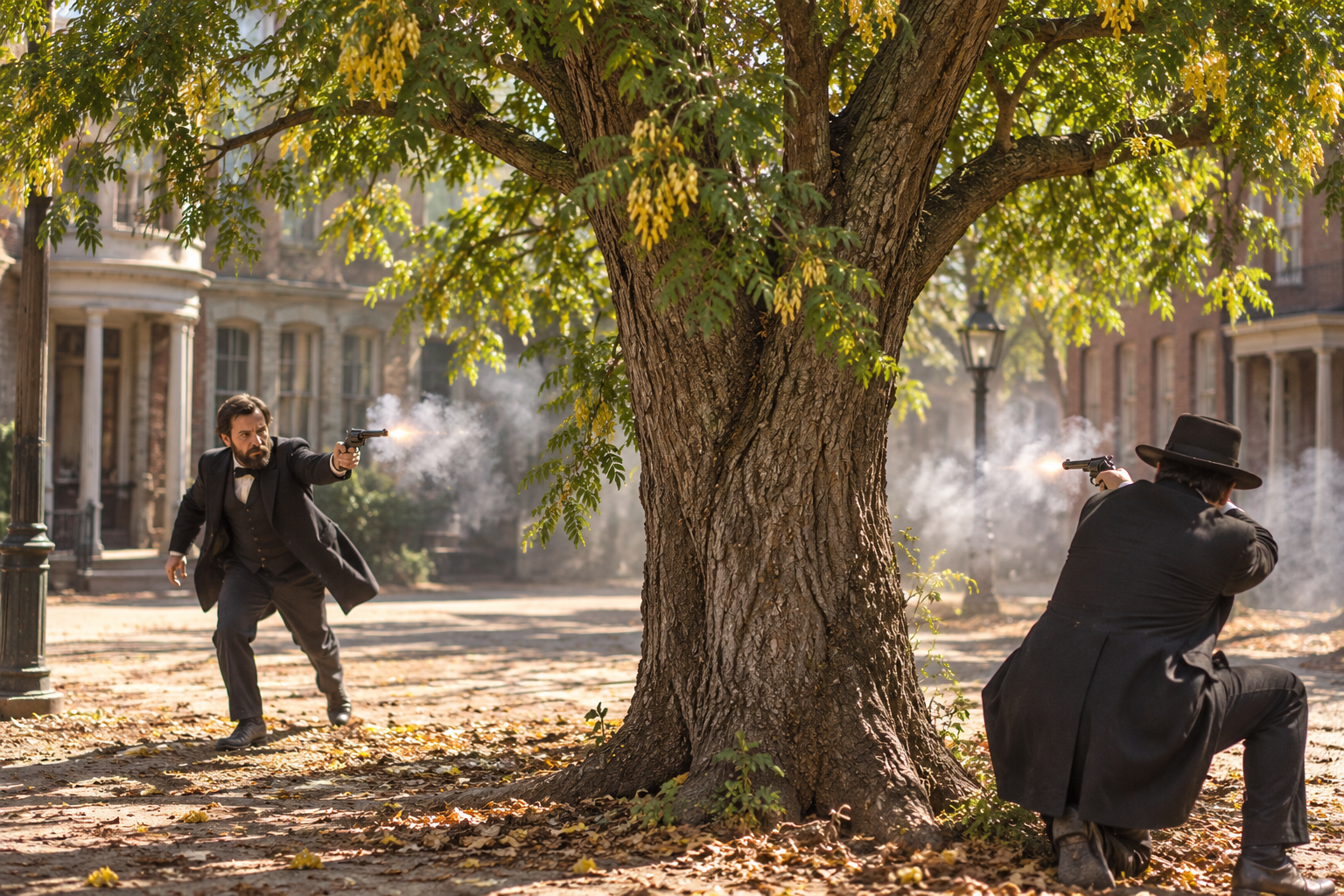
Image Credit: AI-generated historical reconstruction of the May 1, 1888, gunfight between Brigadier General William Wirt Adams and newspaper editor John H. Martin on President Street in Jackson, Mississippi. Created with ChatGPT using an actual photograph of a chinaberry tree for visual reference. Scene based on eyewitness accounts published in “A Terrible Tragedy,” The Times-Democrat (New Orleans, Louisiana), May 1888. The image is an artistic interpretation, not an authentic historical photograph.
Confederate cavalry commander, Mississippi politician, and Jackson postmaster William Wirt Adams survived four years of warfare, only to lose his life in a gunfight with a newspaper editor on a Jackson street.
On the afternoon of May 1, 1888, two prominent Jackson residents encountered one another on President Street near its intersection with Amite Street. One was Brigadier General William Wirt Adams, a former Confederate cavalry commander who had become Jackson's postmaster. The other was John H. Martin, editor of the New Mississippian, a newspaper that had repeatedly attacked Adams in its pages.
The men had been feuding for weeks. Martin had published several unflattering articles about the general, including another that very morning. Whatever restraint had kept their dispute confined to the printed page disappeared when the two men met shortly after 2:00 p.m.
Within moments, both men had drawn pistols. Shots rang out along President Street. When the gunfire stopped, both Adams and Martin were mortally wounded.
The entire encounter lasted less than a minute.
For Adams, it was a remarkable and tragic conclusion to a life that had taken him from the Republic of Texas to the battlefields of the Civil War and eventually into the political and civic life of Mississippi's capital city.
From Natchez to the Republic of Texas
William Wirt Adams was born in Frankfort, Kentucky, on March 22, 1819. His father, George Adams, was a federal judge whose appointment brought the family to Natchez, Mississippi, while William was still young.
Growing up in Natchez, Adams belonged to a family with considerable political and social connections. As a young man, however, he looked westward for adventure and opportunity.
In the late 1830s, Adams traveled to the Republic of Texas, which had won its independence from Mexico in 1836 but had not yet joined the United States. He served in the Texas military during the republic's turbulent early years, gaining experience that would prove valuable more than two decades later.
Eventually, Adams returned to Mississippi, where he became involved in planting, banking, and politics. He served in the Mississippi legislature and established himself among the state's influential citizens.
By the time Mississippi seceded from the Union in January 1861, Adams was a successful businessman and an experienced political figure.
The General Who Turned Down Jefferson Davis
When Jefferson Davis organized the Confederate government in 1861, Adams was reportedly offered the position of postmaster general. It was a prestigious opportunity that would have placed him among the highest officials of the new Confederate government.
Adams declined.
Instead of accepting a cabinet position, he chose military service, organizing a cavalry regiment that became known as the 1st Mississippi Cavalry.
His decision placed him in the field rather than behind a desk in Richmond.
Throughout the Civil War, Adams and his cavalrymen operated across Mississippi and neighboring states. Cavalry units performed essential duties, including scouting, gathering intelligence, protecting supply routes, and disrupting enemy movements.
Adams participated in operations connected with the Vicksburg Campaign, one of the war's most consequential struggles. His command was involved in efforts to counter Union cavalry raids and protect Confederate communications.
In September 1863, Adams was promoted to brigadier general. He subsequently served in Confederate cavalry operations in Mississippi and the western theater, including service associated with General Nathan Bedford Forrest.
When the Confederacy collapsed in 1865, Adams had survived the conflict and returned to civilian life.
He would spend the next twenty-three years rebuilding his career in a Mississippi profoundly changed by war and Reconstruction.
A Confederate General Becomes a Federal Postmaster
After the Civil War, Adams resumed his involvement in Mississippi politics and public affairs. He served as state revenue agent, a position that brought him into contact with questions of taxation, property, and government administration.
His political connections eventually led to another appointment, this time from a president of the United States.
In 1885, President Grover Cleveland appointed Adams postmaster of Jackson.
There was considerable irony in the appointment. The man who had declined the opportunity to become postmaster general of the Confederacy now held a federal postal appointment under the government he had once fought against.
By 1888, Adams was approaching his seventieth year. He was a familiar figure in Jackson, respected by many for his wartime service and public career, but he was not without critics.
One of those critics was newspaper editor John H. Martin.
A Newspaper Feud Turns Deadly
During the spring of 1888, Martin used the pages of the New Mississippian to criticize Adams. The attacks became increasingly personal, questioning the general's character and accusing the Jackson post office of interfering with the newspaper's mail distribution.
On May 1, Martin published another attack, referring sarcastically to Adams as "Gen. Wirt Certificate Adams" and suggesting that the post office was attempting to punish the newspaper for its criticism.
That afternoon, the two men encountered each other on President Street.
A contemporary account published in the New Orleans Times-Democrat described the confrontation in extraordinary detail.
Adams was walking north with a companion identified as Mr. Farish, while Martin was traveling south. As they approached each other, Adams reportedly confronted the editor.
According to Farish, Adams called Martin a "damned rascal" and declared that he had taken enough abuse from him.
Martin reportedly replied, "If you don't like it," before drawing his pistol and firing.
Farish believed Martin fired first, although he acknowledged that he could not be certain.
Martin moved behind a large chinaberry tree near the edge of the sidewalk, using it for protection as the two men exchanged shots. Adams advanced around the tree while firing his own revolver.
It was a brief but deadly encounter, witnessed by people in the surrounding buildings.
An Eyewitness from Another Greenwood Cemetery Family
One of the most interesting eyewitness accounts came from Thomas Helm Jr., who was sitting at a window across President Street, approximately sixty feet from the gunfight.
Helm saw Adams and Farish approaching along the street. After they passed beyond his direct line of sight, he heard a gunshot and turned to see what was happening.
According to the Times-Democrat, Helm saw Martin kneeling behind the tree and firing at Adams. The general was moving around the tree in an attempt to reach Martin while returning fire.
Martin then moved south of the tree, continuing to shoot. Adams followed, but collapsed before the confrontation could continue.
The Helm name is already familiar to readers of Greenwood Cemetery's Gone But Not Forgotten series. Thomas and Mary Helm were prominent Jackson residents whose story includes their family's connection to Mt. Helm Baptist Church and the yellow fever epidemic of 1878.
Their story is told in our earlier article, A Church, an Epidemic, and the Legacy of Thomas and Mary Helm.
The appearance of Thomas Helm Jr. in the newspaper account reminds us how closely connected the lives of nineteenth-century Jackson residents could be. A man associated with one Greenwood family was present at the fatal encounter of another future Greenwood resident.
Two Men Dead in Less Than a Minute
The Times-Democrat reported that both men died in less than a minute.
Martin, who had been wounded in the chest and upper leg, reportedly told those who rushed to his assistance, "I am dead."
He died almost immediately.
Adams never spoke. A bullet had passed directly through his heart.
The newspaper provided a detailed accounting of the weapons used in the confrontation. Both men carried .44-caliber Colt revolvers. All six cartridges in Martin's pistol had been fired. Adams had fired three shots, and a fourth cartridge showed evidence that the hammer had fallen without discharging the weapon.
The gunfight shocked Jackson.
"An untold gloom hangs over, and the deepest sorrow pervades this community in consequence of this terrible tragedy," the Times-Democrat reported.
Adams had survived cavalry engagements, military campaigns, and the destruction of the Confederacy. Yet a chance encounter on a Jackson sidewalk ended his life.
General Adams Comes to Greenwood Cemetery
William Wirt Adams was buried in Greenwood Cemetery in Jackson, where his grave remains a reminder of one of the city's most dramatic nineteenth-century tragedies.
His burial also connects him to another Confederate general in his own family. His brother, Brigadier General Daniel Weisiger Adams, is reported to be buried nearby in an unmarked grave.
For visitors walking through Greenwood Cemetery, William Wirt Adams's name may initially suggest the familiar story of a Confederate officer who survived the Civil War and returned home.
But his life was considerably more complicated.
They also remind us that Greenwood Cemetery is more than a collection of individual graves. Its residents shared the same streets, institutions, controversies, and communities. Their stories often intersect in ways that continue to surprise us.
