Lewis Thomas Fitzhugh: Mississippi's Visionary Founder of Belhaven University
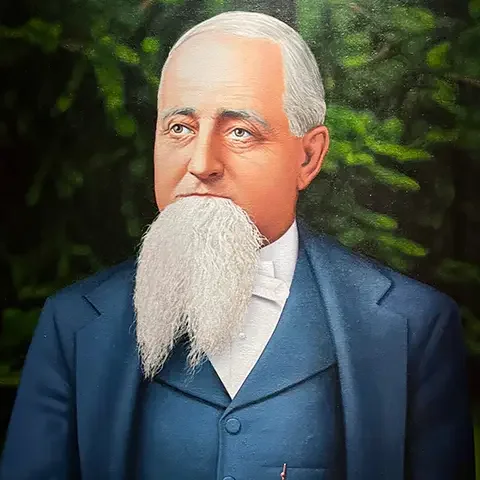
Image Citation: Portrait of Dr. Lewis Thomas Fitzhugh from Belhaven University's official history page. Courtesy of Belhaven University. https://www.belhaven.edu/about/mission/history.html
Among the educators buried at Greenwood Cemetery, few left a greater mark on Mississippi than Dr. Lewis Thomas Fitzhugh. Remembered as the founder of Belhaven College, Fitzhugh devoted nearly four decades to education, helping shape generations of students before establishing one of the state's most enduring Christian institutions.
Lewis Thomas Fitzhugh was born in Brandon, Mississippi, on June 10, 1841, the son of Drew and Martha Fitzhugh. He attended Centenary College in Jackson, Louisiana, but his education was interrupted by the Civil War, during which he served as a Confederate soldier. After returning home, he chose the classroom over other professions, beginning a career that would span nearly forty years.
Follow us on Facebook and Instagram
His first teaching assignment was at Sylvarena in Smith County. He later led the school at Fannin before joining the University of Mississippi in Oxford, where he directed the university's preparatory department. His reputation as an educator continued to grow, eventually leading to his appointment as president of Whitworth College in Brookhaven, one of Mississippi's leading institutions for women's education.
In 1894, Fitzhugh moved to Jackson with an ambitious vision: establishing a first-class Christian college for young women. He founded Belhaven College in the former home of Colonel Jones Hamilton on Boyd Street. The college was named "Belhaven" after Hamilton's ancestral home in Scotland. Just seven months after opening, disaster struck when the original building was destroyed by fire on February 7, 1895. Rather than abandon the project, Fitzhugh immediately began rebuilding. A larger and more impressive campus opened the following year, ensuring that his dream would continue.
Under Fitzhugh's leadership, Belhaven quickly earned a reputation as one of the South's premier colleges for women. His contemporaries credited his "great ability, energy and perseverance" for building the institution from the ground up despite enormous financial and logistical challenges.
True to the Public Trust Since 1823
From Pulitzer Prize winners to those who served from the War of 1812 through WWII, Greenwood is a chronicle of sacrifice and success. Help us fund the research, tours, and preservation efforts that bring this history to life. Join us in honoring the depth and complexity of the Mississippi story.

Image Citation: AI-generated illustration of Fitzhugh Hall on the campus of Belhaven University, created from a contemporary photograph of the building.
Although deeply committed to his work, Fitzhugh's health began to fail during the final years of his life. Seeking treatment, he traveled to Chicago to consult leading specialists, and upon returning to Jackson appeared to be improving. On Sunday afternoon, however, September 18, 1904, he suddenly experienced difficulty breathing while reading in his home on the Belhaven campus. Within minutes he died of heart disease at the age of sixty-three. His unexpected passing shocked both the college community and the city of Jackson.
His funeral was held at First Methodist Church in Jackson, drawing many of Mississippi's leading public officials and educators. Honorary pallbearers included Governor James K. Vardaman, former Governors A. H. Longino and Robert Lowry, Chief Justice A. H. Whitfield, and other prominent civic leaders, reflecting the statewide respect he had earned through his educational service.
Fitzhugh's influence extended beyond his own lifetime through his family. His daughter, Beulah Fitzhugh, married Bishop William Belton Murrah, the first president of Millsaps College, linking two of Mississippi's most significant Christian educational institutions. Both are also buried at Greenwood Cemetery, making this section of the cemetery a remarkable intersection of Mississippi's educational history.
Do You Have More Information to Share?
Our historical research is never truly finished. Whether you have insights into our antique rose collection or stories of ancestors who rest here, your contribution helps Mississippi’s past come to life.
Belhaven continued to grow after Fitzhugh's death. The college changed ownership several times, survived additional devastating fires in 1910 and 1927, relocated to its present campus on Peachtree Street, and eventually became Belhaven University in 2010. Today it serves thousands of students while maintaining its commitment to Christian higher education. One of the university's landmark buildings, Fitzhugh Hall, bears the founder's name, ensuring that each new generation remembers the man whose vision made the institution possible.
Today, Dr. Fitzhugh's story is once again being told through a unique partnership between Greenwood Cemetery and Belhaven University. As part of Greenwood Cemetery's mission to preserve Mississippi's history, the cemetery has partnered with Belhaven University's Film Production Department to create an ongoing series of short historical films highlighting many of the remarkable individuals buried at Greenwood. The collaboration gives Belhaven students valuable hands-on experience in documentary filmmaking while helping preserve the stories of Mississippi's most influential citizens.
It is especially fitting that one of the first films produced in the series tells the story of Lewis Thomas Fitzhugh. More than 130 years after he founded Belhaven College, students at the university he established are now helping preserve and share his story with new generations. The film was produced by Belhaven film students under the guidance of faculty as part of the Greenwood Cemetery Film Series, demonstrating how history, education, and storytelling continue to intersect through this innovative partnership.
Watch the film:
https://www.youtube.com/watch?v=ixPXL7k30mM
Visitors to Greenwood Cemetery may see only a modest monument marking Lewis Thomas Fitzhugh's grave, yet his true memorial stands only a few miles away. Every graduate of Belhaven University traces part of their educational heritage to the determination of one Mississippi educator who believed Christian higher education could flourish in Jackson. More than a century after his death, that vision continues to educate students, strengthen communities, and inspire new generations—including those now telling his story through film.
