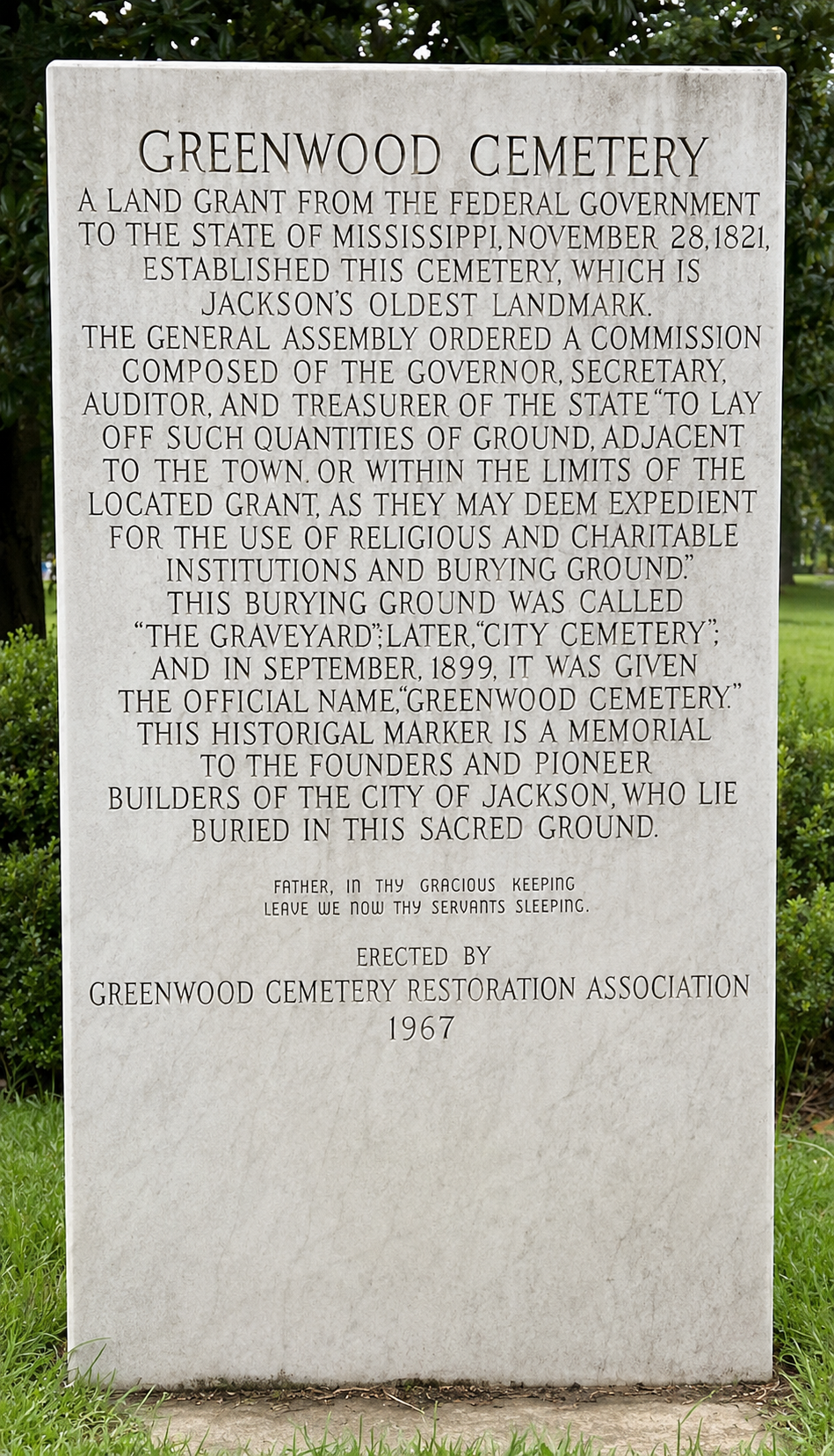
AI enhanced from a photo taken by the author.
On the left-hand side after entering Greenwood Cemetery on Central Avenue, just before reaching the wisteria arch, visitors are greeted by a marble monument erected in 1967 that reads:
GREENWOOD CEMETERY
A LAND GRANT FROM THE FEDERAL GOVERNMENT
TO THE STATE OF MISSISSIPPI, NOVEMBER 28, 1821,
ESTABLISHED THIS CEMETERY, WHICH IS
JACKSON'S OLDEST LANDMARK.
THE GENERAL ASSEMBLY ORDERED A COMMISSION
COMPOSED OF THE GOVERNOR, SECRETARY,
AUDITOR, AND TREASURER OF THE STATE "TO LAY
OFF SUCH QUANTITIES OF GROUND, ADJACENT
TO THE TOWN, OR WITHIN THE LIMITS OF THE
LOCATED GRANT, AS THEY MAY DEEM EXPEDIENT
FOR THE USE OF RELIGIOUS AND CHARITABLE
INSTITUTIONS AND BURYING GROUND."
THIS BURYING GROUND WAS CALLED
"THE GRAVEYARD"; LATER, "CITY CEMETERY";
AND IN SEPTEMBER, 1899, IT WAS GIVEN
THE OFFICIAL NAME, "GREENWOOD CEMETERY."
THIS HISTORICAL MARKER IS A MEMORIAL
TO THE FOUNDERS AND PIONEER
BUILDERS OF THE CITY OF JACKSON, WHO LIE
BURIED IN THIS SACRED GROUND.
FATHER, IN THY GRACIOUS KEEPING
LEAVE WE NOW THY SERVANTS SLEEPING.
ERECTED BY
GREENWOOD CEMETERY RESTORATION ASSOCIATION
1967
Follow us on Facebook and Instagram
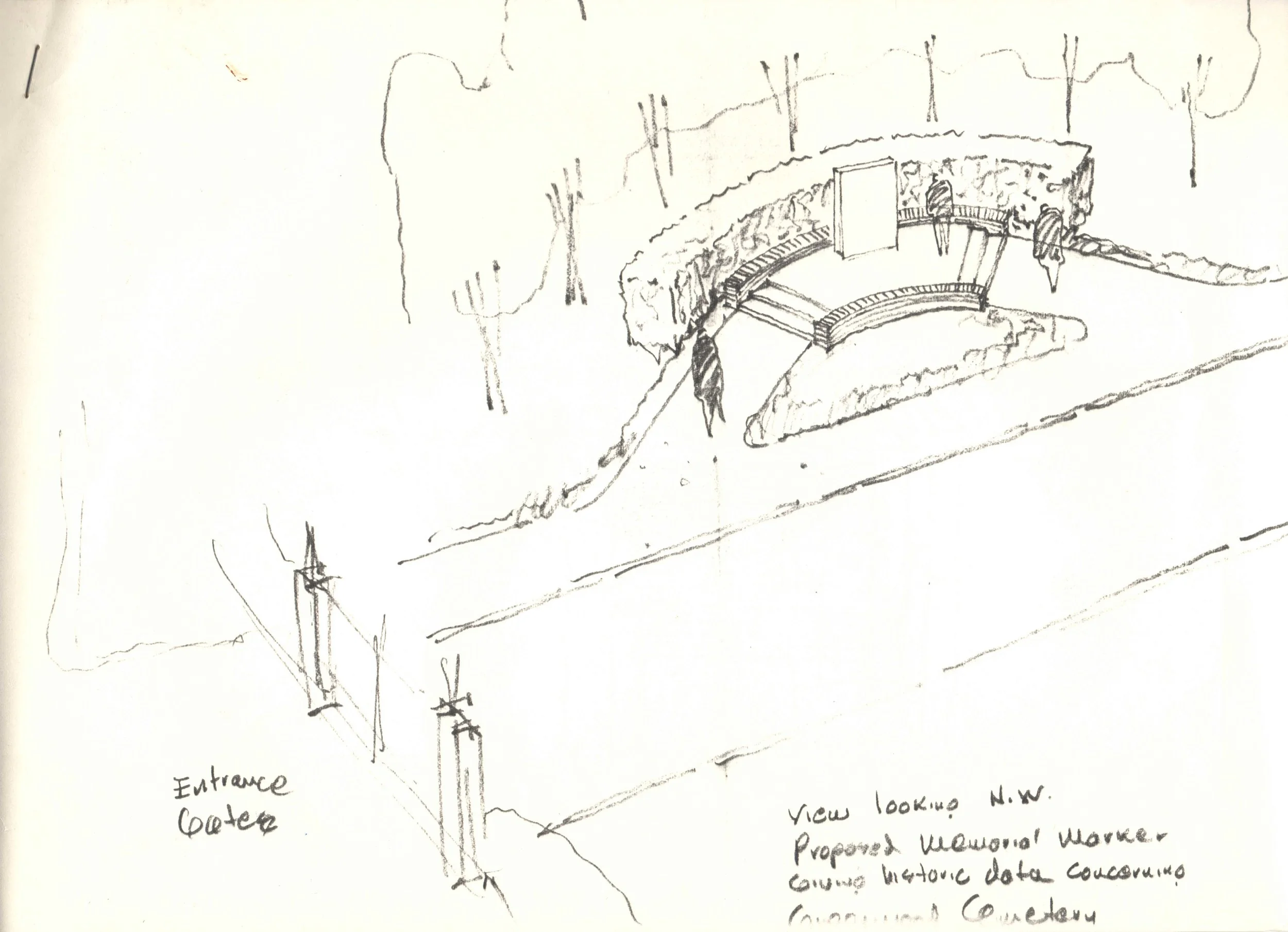
An original drawing of the proposed monument location by an unknown “sketcher”.
The cemetery's historical records show there were several monument designs bandied about among the leadership of the Greenwood Cemetery Restoration Association (the official name of our governing nonprofit), but even more discussion seems to have centered on what the monument should actually say.
One early draft read:
"LORD GOD OF HOST BE WITH US YET, LEST WE FORGET, LEST WE FORGET.
We herein dedicate this historic marker as a memorial to the founders and pioneer builders of the city of Jackson, who now rest in this hallowed ground.
A land grant to the General Assembly, Jackson, Mississippi, November 28, 1821, established the first town cemetery. In part the General Assembly Act ordered, 'To lay off such quantities of ground, adjacent to the town, or within the limits of the located grant, as they may deem expedient, for the use of religious or charitable institutions and burial grounds.' This burial ground was located just north of Jackson on the outskirts of the town.
The first map of the cemetery, in relation to the city of Jackson, was a survey made by P. H. Van Dorn in 1822. It is noted from that map that the cemetery was called the graveyard. Being the only cemetery in Jackson, it was later referred to as the city cemetery. It was officially named Greenwood Cemetery September 1899.
Memorial Day was established in this cemetery April 26, 1865, by placing flowers on the graves of the recently buried Confederate and Union soldiers.
Several hundred of the defenders of our city, who were killed in or around Jackson, rest in the Confederate burial plot. Over two hundred of these brave warriors are unknown but to God."
(Another story for another day is how many Southern cemeteries have claimed to be the first to place flowers on the graves of Union soldiers.)
True to the Public Trust Since 1823
From Pulitzer Prize winners to those who served from the War of 1812 through WWII, Greenwood is a chronicle of sacrifice and success. Help us fund the research, tours, and preservation efforts that bring this history to life. Join us in honoring the depth and complexity of the Mississippi story.
Notice the difference between one of the lines in the final monument and the draft.
The monument reads:
"A land grant from the Federal Government to the State of Mississippi...established this cemetery...."
The earlier draft instead stated:
"A land grant to the General Assembly, Jackson, Mississippi, November 28, 1821, established the first town cemetery."
At first glance, the statement on the 1967 monument seems straightforward. But Greenwood's own historical records—and the original laws passed by Mississippi's Legislature—reveal a story that is even more interesting.
The process actually unfolded in stages.
Mississippi became the twentieth state on December 10, 1817, but there was one problem: the state did not yet have land available for a permanent capital located near the geographic center of the state. That changed with the Treaty of Doak's Stand in October 1820, when the Choctaw Nation ceded millions of acres to the United States. Congress had already granted Mississippi land for its permanent seat of government, but only after the treaty could that grant be put to use.
The Mississippi Legislature first appointed General Thomas Hinds, former Territorial Delegate William Lattimore, and James Patton—who would later serve as lieutenant governor under our own Governor George Poindexter—to identify the best location for the new capital. After surveying several possibilities, the commissioners recommended LeFleur's Bluff on the Pearl River.
Do You Have More Information to Share?
Our historical research is never truly finished. Whether you have insights into our antique rose collection or stories of ancestors who rest here, your contribution helps Mississippi’s past come to life.
The General Assembly—the name for Mississippi's Legislature at the time—accepted that recommendation. On November 28, 1821, it passed a supplemental act authorizing Hinds, Lattimore, and Peter A. Van Dorn to establish the capital on the designated federal land grant and lay out the new town of Jackson.
The act began:
"Be it enacted by the Senate and House of Representatives of the State of Mississippi, in General Assembly convened, That Thomas Hinds and William Lattimore, commissioners appointed by the act to which this is a supplement, and Peter A. VanDorn be, and they are hereby authorized and empowered to locate...a permanent seat of government for this state."
Notice the phrase, "the act to which this is a supplement." Even the Legislature recognized that the November 1821 law was not the beginning of the story. It was the continuation of work already underway.
Once the location had been fixed and the town laid out, the Legislature turned to another responsibility. As Greenwood's monument correctly notes, it directed a commission consisting of the Governor, Secretary of State, State Auditor, and State Treasurer:
"...to lay off such quantities of ground, adjacent to the town, or within the limits of the located grant, as they may deem expedient for the use of religious and charitable institutions and burying ground."
Those words are the legal foundation of Greenwood Cemetery. Their decision ensured that Jackson would have a public burial ground.
The Legislature did not ask these officials to create a cemetery from newly donated federal land. Rather, it instructed them to reserve portions of the capital lands already selected for public purposes. Among those reservations was a public burying ground—the cemetery that would later become known as Greenwood.
So, was the monument wrong? Maybe it's all just semantics?
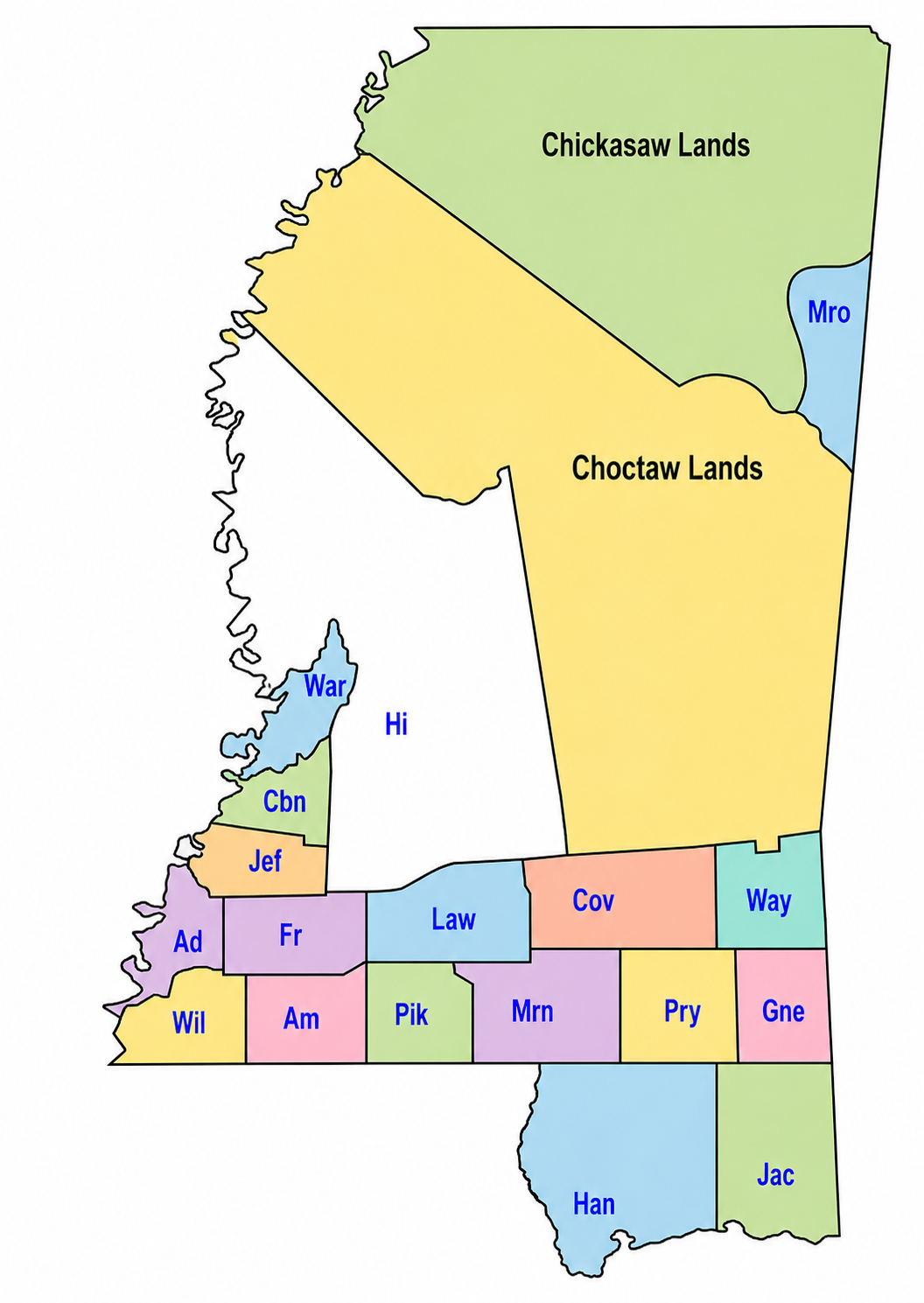
An 1821 county map of Mississippi - note “Hi” in the large white area was all called Hinds County at the time of the establishment of Jackson as the capital. Adapted from MapofUS Mississippi County Maps, https://www.mapofus.org/mississippi/. Digitally enhanced and colorized using OpenAI ChatGPT (2026).
Not at all.
The monument correctly links Greenwood's origins to the federal land grant that made Mississippi's permanent capital possible. What it understandably compresses into a single sentence is the sequence of events that connected one to the other. The Treaty of Doak's Stand opened the land. Hinds, Lattimore, and Patton selected LeFleur's Bluff as the future capital. The General Assembly authorized Hinds, Lattimore, and Van Dorn to survey and lay out the new city of Jackson. Finally, the Governor and the other statewide elected officials reserved land for churches, charitable institutions, and a public burying ground.
In other words, the federal land grant did not directly establish Greenwood Cemetery. It established the opportunity. Greenwood was born when Mississippi's earliest leaders deliberately set aside part of the new capital reservation for a public cemetery.
Perhaps that is the real value of revisiting Greenwood's history. The 1967 monument was never intended to be a legal brief. Its purpose was to honor the founders and pioneer builders of Jackson whose lives are intertwined with this sacred ground. Nearly sixty years later, the monument still accomplishes that purpose.
Our review of the Greenwood Cemetery Restoration Association's records, the monument drafts, and the original legislative acts simply allows us to appreciate the story in greater detail. Rather than diminishing the monument's message, the original documents enrich it. They remind us that Greenwood was not created by a single act or a single day, but by a remarkable sequence of events involving the Treaty of Doak's Stand, Mississippi's earliest lawmakers, the commissioners who selected LeFleur's Bluff, and the state officials who reserved land for a public burying ground.
For visitors walking past the marble monument today, the words carved in stone remain true. They simply tell the beginning of a story that is even richer than the monument's authors could have imagined. Nearly two centuries after those first acres were reserved, Greenwood Cemetery continues to stand as one of Jackson's oldest landmarks and one of Mississippi's most important historic places.
