“O Lord, Let Not This Vile Act Become Law” : Reverend John W. Harmon: From a Landmark US Supreme Court Decision to Rebuking the Mississippi’s Legislature
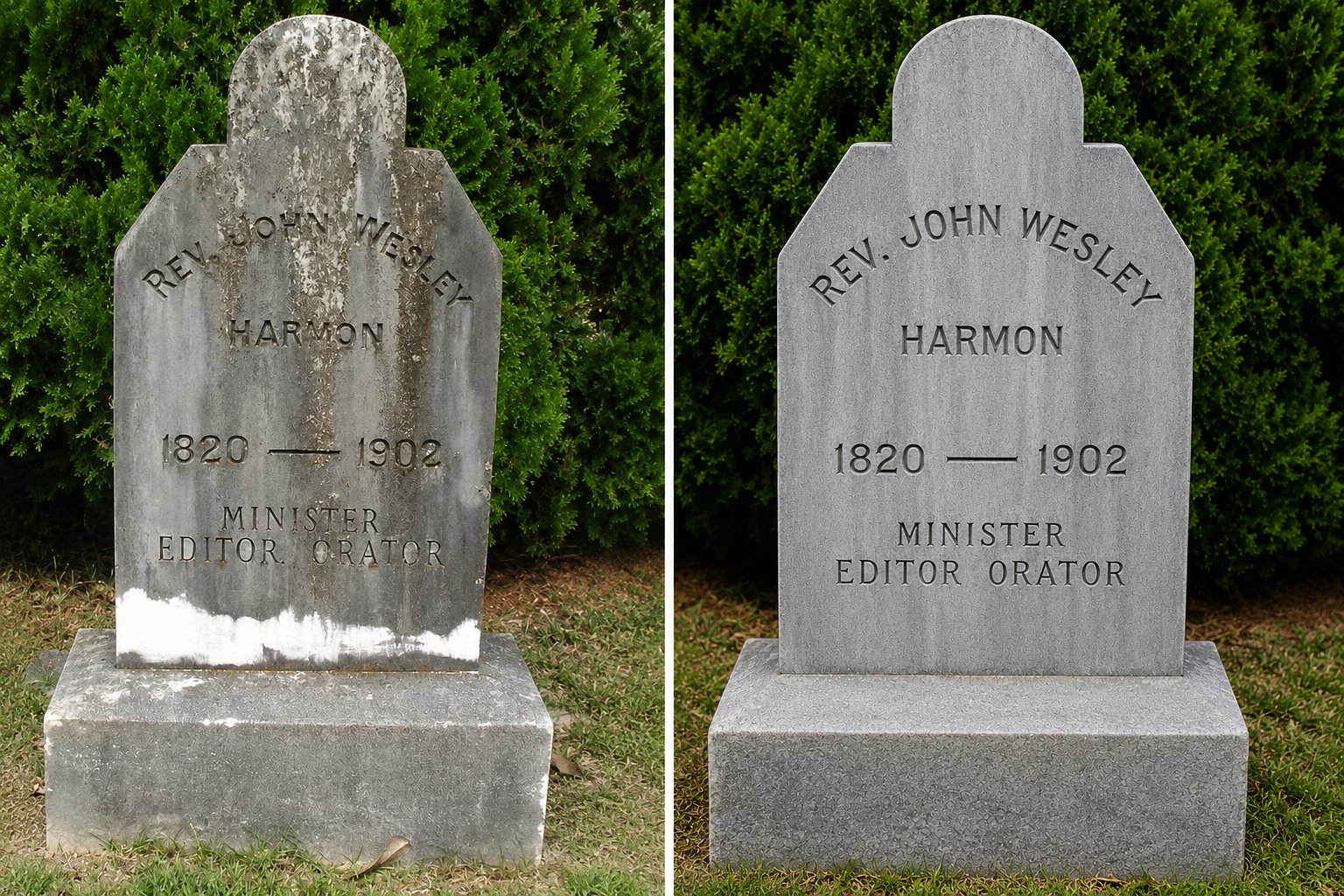
Original gravestone photograph from Find A Grave memorial for Reverend John Wesley Harmon. Side-by-side comparison image includes the unaltered original photograph and an AI-enhanced restoration created for presentation purposes to improve legibility and visual clarity while preserving the original inscription.
Mary King Harmon was tending to her new baby when the wife of the local Presbyterian minister called on her. In his sermon the previous Sunday the Presbyterian minister had attacked the Reverend John Wesley as a “hypocrite, deceiver, and liar, plunging him into the flames of perdition.” When the visitor asked the name of Mary’s infant, she immediately told him that if the baby was a boy she intended to name her John Wesley. True to his namesake, he finally yielded to the call to become a Methodist minister and remained faithful to the calling the rest of his life.
Follow us on Facebook and Instagram
John Wesley Harmon was born in Augusta, Bracken County, Kentucky on February 12, 1820, or on February 12, 1821, or perhaps on February 12, 1822. Two of the dates came from John’s pen and one from family memory. While his father, Zebulon Harmon, was a trustee of Augusta College where they lived, and his mother, Mary King, was born in Leicestershire, England, Augusta College, founded in 1822, was the first Methodist college to be established. John entered when he was only twelve years of age and after studying for several years was denied a diploma because of his youth. Subsequently, the family moved to St. Charles College. When his father’s merchandising business failed, he was forced to drop out of school just three months short of graduating.
John then entered the teaching profession. In the back of his mind was always the thought that he was destined to enter the ministry, a calling he tried to evade. To that end he entered the Ohio State Medical University at Cincinnati. While he was a student there, he attended a revival in the Wesley Chapel conducted by Reverend John Newland Maffitt. Reverend Maffitt was later elected to the United States House of Representatives on December 6, 1841. During the revival John yielded to the call to preach. Shortly after he was licensed to preach and joined the Mississippi Annual Conference. During one of the conferences he introduced a resolution to make Louisiana a conference by itself. Apparently this did not sit too well with the grey-haired presiding elder, for he was told to pack his bags and go to New Orleans where there arrived about 1842. He became the pastor of the Methodist church on Magazine Street which later merged with the wealthy Felicity Street Church.
True to the Public Trust Since 1823
From Pulitzer Prize winners to those who served from the War of 1812 through WWII, Greenwood is a chronicle of sacrifice and success. Help us fund the research, tours, and preservation efforts that bring this history to life. Join us in honoring the depth and complexity of the Mississippi story.
As he labored in New Orleans he developed his passion for temperance and introduced a temperance resolution during a conference in 1849. He remarked that “An invitation to drink at funerals where an ample apology was necessary to smooth over the offenses...” Whatever his temperance views in New Orleans, whether the cause or not, he was reassigned to Baton Rouge. One Saturday night during a Conference Mission Meeting he noticed three young ladies who were in attendance. He was particularly attracted to one of the girls, and an inner voice told him that she was his future wife. After the meeting two gold bracelets were passed around and he redeemed them and determined to find the donor. Later that evening at dinner he was introduced to the same young lady, and it turned out that she had donated the bracelets. The courtship began almost immediately. On July 25, 1849, Frances Eveline Stewart became his bride in East Baton Rouge. Their marriage was blessed with five sons and three daughters. Reverend Harmon continued his crusade for temperance and eventually founded the Southern Organ to further his temperance agenda. At one time he had 3,000 subscribers. He counted the removal of drinking places from saloons as one of his greatest achievements.
Do You Have More Information to Share?
Our historical research is never truly finished. Whether you have insights into our antique rose collection or stories of ancestors who rest here, your contribution helps Mississippi’s past come to life.
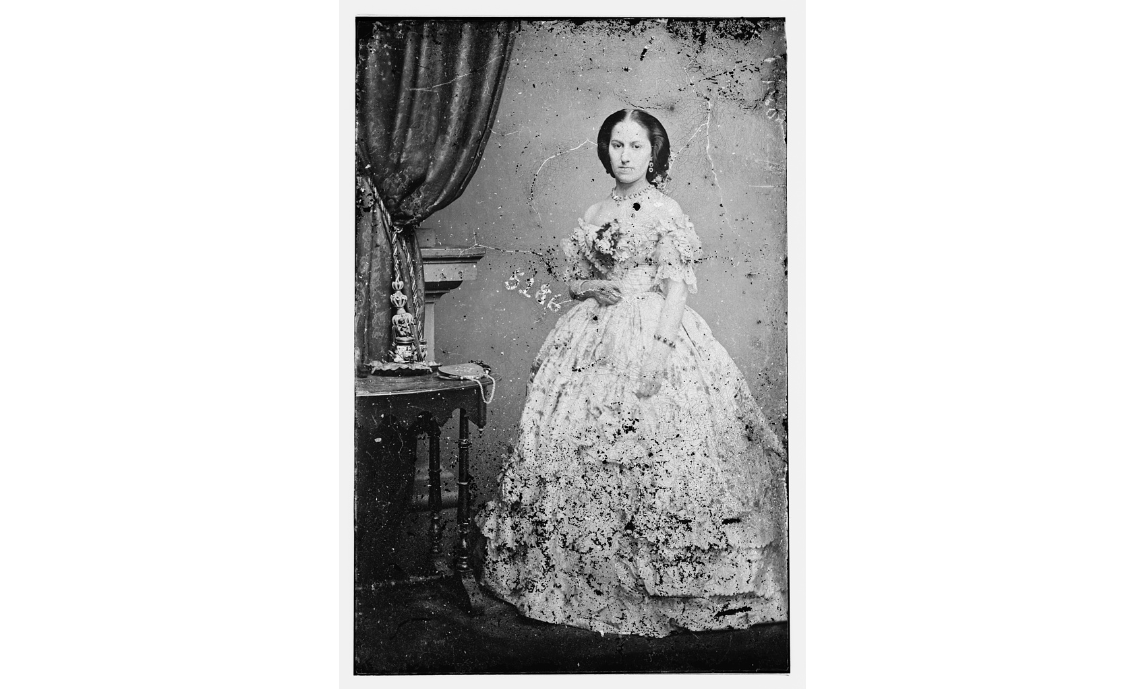
Myra Clark Gaines. , None. [Between 1855 and 1865] Photograph. https://www.loc.gov/item/2017896491/.
In 1855 Myra Clark Gaines, the widow of General Edmund P. Gaines who had died of cholera in 1849, became a boarder, or more correctly in the view of Mrs. Harmon, a freeloader, in the household of Reverend Harmon. Since 1834 she had been trying to establish herself as the rightful heir to the vast fortune left by the timely death of Daniel Clark. Her suit against the Daniel Clark estate was a long legal battle before she died in which she acknowledged that Myra was his legitimate daughter and made her his chief beneficiary.
Unfortunately, upon his death, the will disappeared and one of his business partners placed an earlier will into probate that made him the executor. Myra attempted to have a reconstituted copy probated as the last legal will of her father. She appealed an adverse ruling to the U.S. Supreme Court where a vacancy existed because a justice had resigned from the bench. Chief Justice was assaulted and had to resign from the bench. For reasons known only to herself, she championed Judge E.T. Merrick for the vacant Supreme Court seat, believing that he would rule favorably in her appeal. Her persuasiveness won over Reverend Harmon. For the first and only time in his life, he became involved in politics. He joined the Whig party and campaigned for Judge Merrick for the Supreme Court, and then campaigned for him. Judge Merrick defeated the Democratic candidate by a large margin.
Judge Merrick, with a majority of the court, declared the reconstituted will probated. This was a turning point in the life of his family. Reverend Harmon believed that the woman was right and continued to make good on her debts to them. She moved on, but continued to fight her case for the rest of her life. It was finally settled by the U.S. Supreme Court in 1892 and became the longest case in judicial history.
Myra will made a bequest to Reverend Harmon, but no one expected anything, since she had died almost penniless. Then one morning Reverend Harmon received a telegram telling him to go to New Orleans as the Gaines case had been settled. Upon arrival, ten thousand dollars was counted out and handed to him. It was indeed a proud moment when he arrived home to show that his faith in Myra those many years had finally been vindicated. He used the money to self-publish Select Sermons by J.W. Harmon.
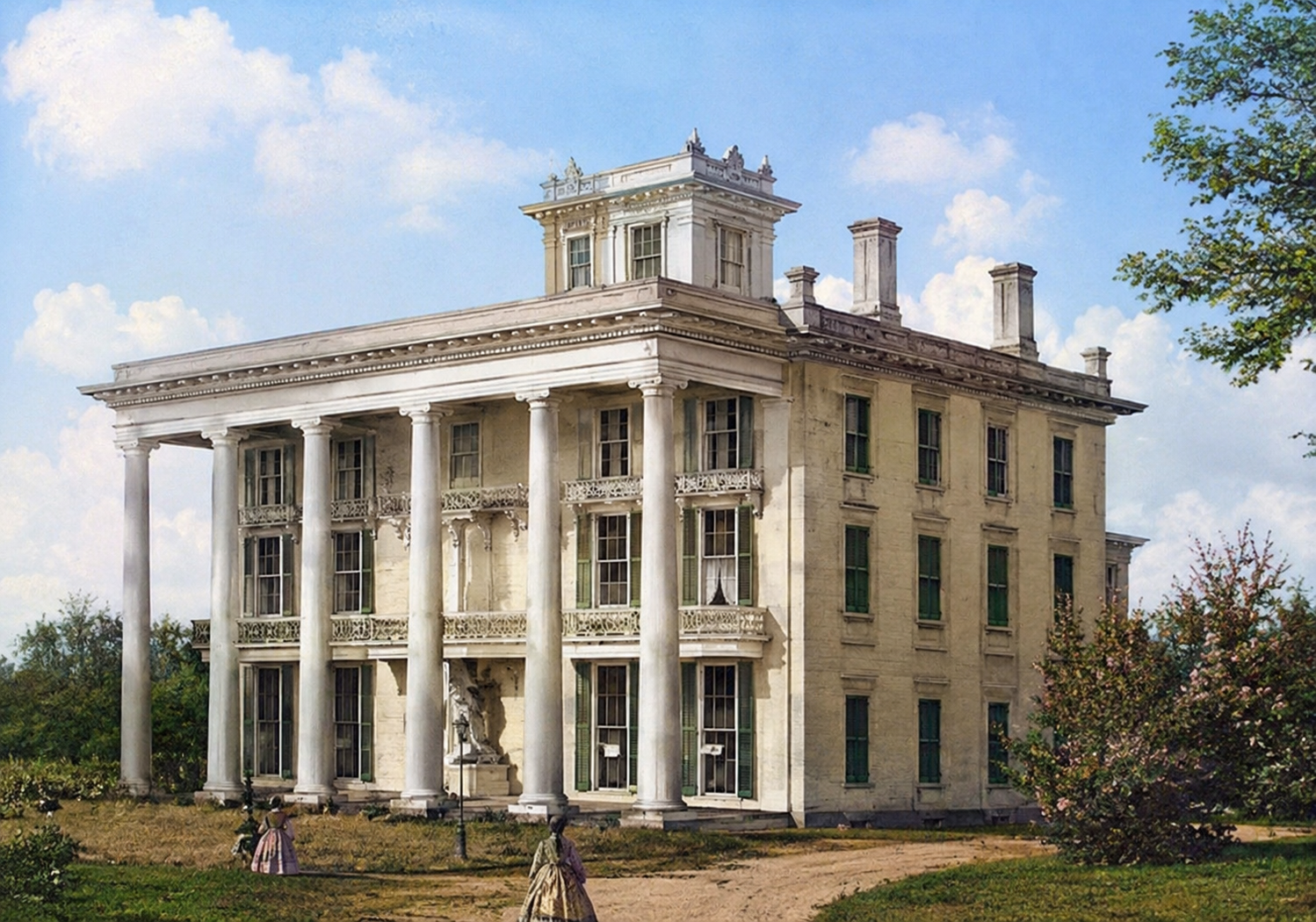
Original composite image: “The Civil War Mississippi Capital buildings utilized after the Battle of Vicksburg from 1863 to 1865.” Courtesy of the Mississippi Department of Archives and History, PI/Printing Plates Collection; originally published in Dunbar Rowland, History of Mississippi: The Heart of the South. This enhanced picture is of the Calhoun Institute in Macon, Mississippi where the Mississippi Legislature met while in ““exile”.
During the Civil War he was the pastor of a church at Macon, Mississippi. The state legislature had taken refuge there after the Federal armies had ravished Jackson. Governor Charles Clark was pushing a bill that would draft all ministers under the age of sixty. The Speaker of the House of Representatives asked Reverend Harmon to give the session’s opening prayer. He did so with a vengeance, attacking the proposed legislation by closing with “O Lord, let not this vile act of legislation become the law of the land.” The bill was defeated.
Although his earlier pastorates were in Louisiana, the later ones were scattered around Alabama and Mississippi with a few breaks as he continued his temperance work. In December of 1891 he was finally retired from the active ministry, termed superannuated, but he continued preaching as the occasion presented itself.
In 1894 he lost his wife just as his book went to press. She was buried in Greenwood Cemetery in Jackson. In late February of 1902 he preached twice on the same day in Meridian. He died March 9, 1902, and was laid to rest beside his wife in Greenwood Cemetery.
An obituary in the New Orleans Christian Advocate said: “With an almost prodigal hand that happy man has scattered flowers along the way of life. He literally broadcasted the fields with seeds and deeds of kindness. The memory of that precious life will itself be a flower of fadeless bloom.”
The graves of Reverend Harmon and his wife are located in Section 2, Lot 130 of Greenwood Cemetery.