Two War of 1812 veterans, two future governors, and two signers of Mississippi's first constitution
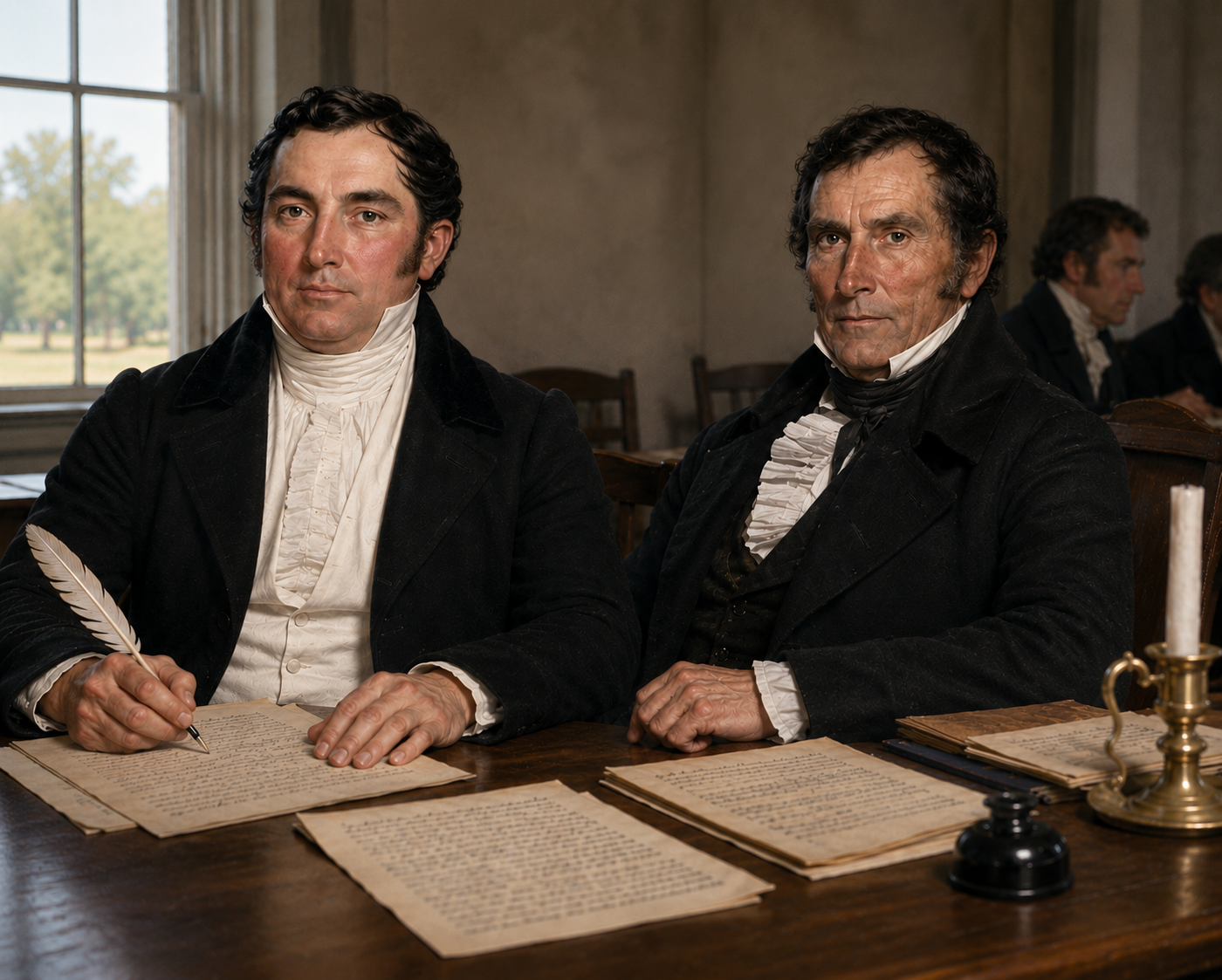
George Poindexter (1779–1853) and Abram Marshall Scott (1783–1833), members of the Wilkinson County delegation to Mississippi's Constitutional Convention of 1817. AI-generated historical reconstruction created from period portraits and contemporary descriptions. OpenAI ChatGPT, 2026.
Visitors to Greenwood Cemetery often discover the graves of governors, senators, military officers, and other notable figures from Mississippi's past. Yet few pairs of Greenwood residents shared as many remarkable experiences as George Poindexter and Abram Scott.
Long before either man occupied the governor's office, they belonged to the generation that guided Mississippi from frontier territory to statehood. Both served during the War of 1812 era. Both represented Wilkinson County at Mississippi's Constitutional Convention of 1817. Both signed Mississippi's first constitution. Both later became governor of the young state they helped create. Today, more than two centuries after Mississippi entered the Union, both rest in Greenwood Cemetery.
Follow us on Facebook and Instagram
Their story begins during one of the most important periods in Mississippi's early history. As the United States fought Great Britain in the War of 1812, the Mississippi Territory occupied a strategic position along the Gulf Coast and lower Mississippi River. The conflict brought military activity to the region and helped shape a generation of leaders who would later guide Mississippi into statehood.
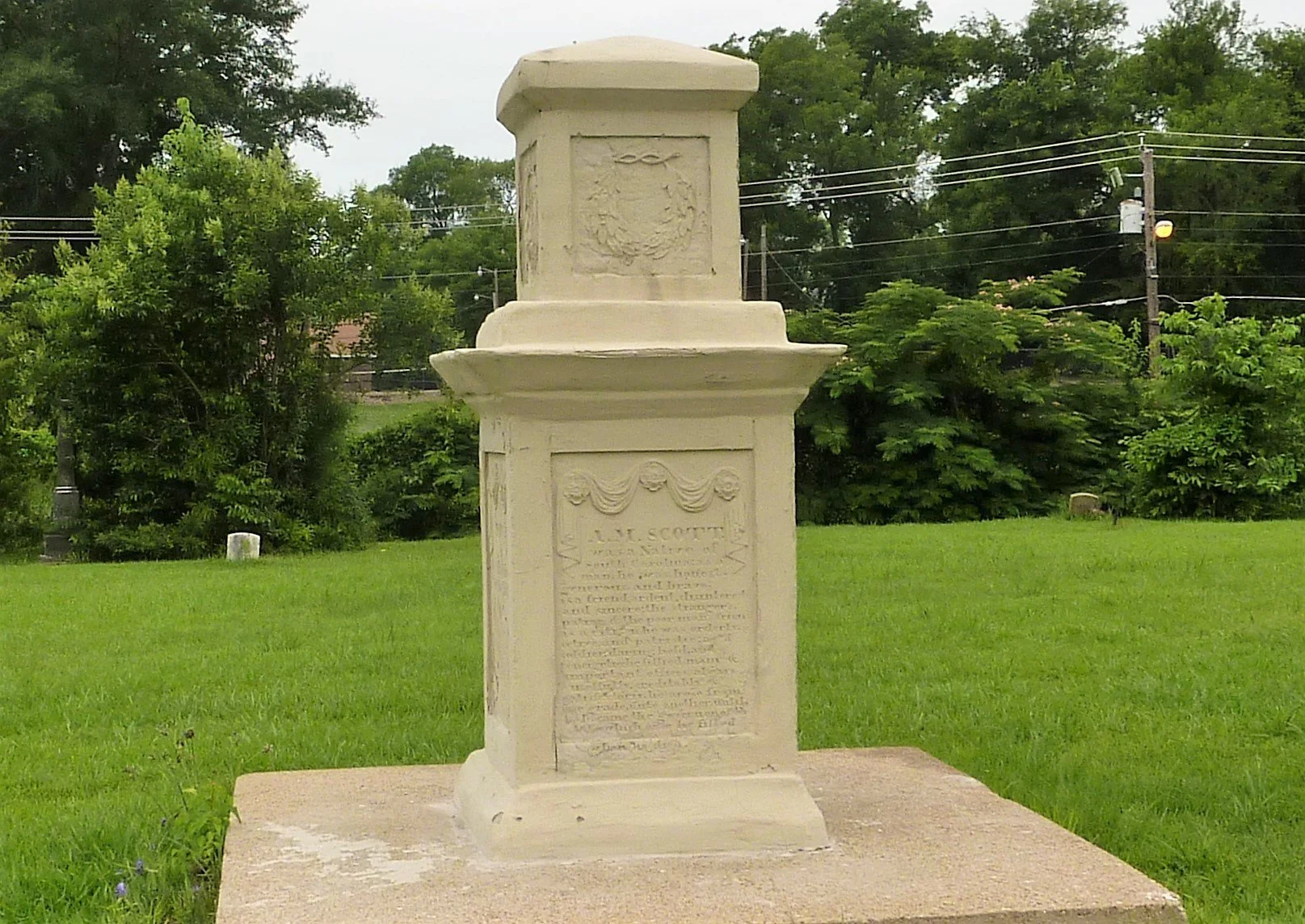
Governor Scott’s monument in Greenwood Cemetery. The material used create the monument is of a very porous material and this is a picture taken by GWC Board Member Linda Robertson just after one of two restorations took place. Today, unfortunately, the material has again disintegrated.
Abram Marshall Scott was among those who answered the call to service. During the Creek War, part of the southern theater of the War of 1812, Scott commanded a company of Mississippi troops under General Andrew Jackson. The experience established his reputation as a capable leader and public servant. After the war, he returned to Wilkinson County, where he continued his legal career and became increasingly active in public affairs.
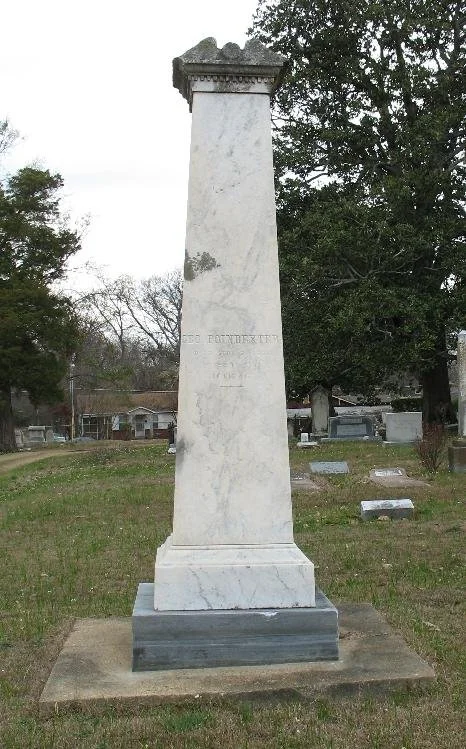
Photo taken from Senator/Governor/Congressman Poindexter’s Find A Grave profile. It sits just to the west of the Cleaver Circle.
George Poindexter followed a different path to prominence. Born in Virginia, he settled in Woodville, Mississippi, in 1802 and quickly established himself as one of the territory's most talented attorneys and political leaders. His legal skill and political influence made him one of the best-known figures in the Mississippi Territory long before statehood arrived.
True to the Public Trust Since 1823
From Pulitzer Prize winners to those who served from the War of 1812 through WWII, Greenwood is a chronicle of sacrifice and success. Help us fund the research, tours, and preservation efforts that bring this history to life. Join us in honoring the depth and complexity of the Mississippi story.
In the spring of 1817, Congress authorized the western portion of the Mississippi Territory to draft a constitution and form a state government. Delegates gathered that summer at Washington, Mississippi, near Natchez, to create the framework for the future State of Mississippi.
Among the delegates were two representatives from Wilkinson County: George Poindexter and Abram Scott. They served together as members of the county's six-man delegation, which also included Daniel Williams, John Joor, Gerard C. Brandon, and Joseph Johnson. The two men were not merely present at the same convention; they represented the same county, worked toward the same goal of statehood, and participated together in one of the most consequential meetings in Mississippi history.
Poindexter quickly emerged as the convention's dominant figure. Historian Dunbar Rowland later described him as the "master-mind and admitted leader of the Convention." As chairman of the committee responsible for drafting the proposed constitution, Poindexter exercised tremendous influence over the final document. Rowland went so far as to write that the constitution ultimately adopted was "mainly the work of Judge Poindexter."
Scott played a different but equally important role. As one of Wilkinson County's delegates, he participated in the debates and deliberations that shaped the new state's government. Together with the other delegates, he helped approve the document that would guide Mississippi into the Union.
Do You Have More Information to Share?
Our historical research is never truly finished. Whether you have insights into our antique rose collection or stories of ancestors who rest here, your contribution helps Mississippi’s past come to life.
When the convention concluded on August 15, 1817, both men placed their signatures on Mississippi's first constitution. A few months later, on December 10, Mississippi officially became the twentieth state admitted to the Union.
For many of the convention delegates, signing the constitution represented the pinnacle of public service. For Poindexter and Scott, however, it was only one chapter in a remarkable series of shared experiences.
Poindexter became Mississippi's second governor in 1820 and later represented the state in both the United States House of Representatives and the United States Senate. Scott continued his rise through state politics, serving as lieutenant governor before becoming Mississippi's seventh governor in 1832.
The parallels between the two men are striking. Both belonged to the War of 1812 generation. Both represented Wilkinson County at the Constitutional Convention of 1817. Both signed Mississippi's first constitution. Both later served as governor. Few pairs of Mississippians can claim such a remarkable sequence of shared experiences during the state's formative years.
Their connection continued long after their public careers ended.
Today, George Poindexter and Abram Scott are buried in Greenwood Cemetery. Unlike many prominent Greenwood residents whose graves are surrounded by generations of family members, both men rest alone with no family members buried with them. Their monuments commemorate not family dynasties but a unique shared place in Mississippi history.
More than two centuries ago, they helped transform a frontier territory into a state. They sat together in the Wilkinson County delegation. Their signatures appeared together on the document that made Mississippi possible. Their names later appeared on the roster of Mississippi governors. Today, their graves remain among Greenwood Cemetery's most direct connections to the state's founding generation.
Before they governed Mississippi, they helped build it.
