From Mississippi Politics to American Music: The Expanding Legacy of the Guion Family
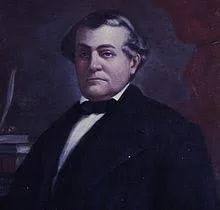
Taken by the author at the Mississippi Capitol
John Isaac Guion emerged from the early nineteenth-century Mississippi frontier to become one of the state’s most respected lawyers and a central figure in its political leadership during a formative period. Born on November 18, 1802, in Adams County in the Mississippi Territory, Guion belonged to a generation shaped by both the legacy of the American Revolution and the rapid expansion of the United States into the lower Mississippi Valley. His father, Major Isaac Guion, was a veteran of the Revolutionary War who later served under General Anthony Wayne and participated in the transfer of Spanish-controlled posts east of the Mississippi into American hands in the late 1790s. This combination of military service and frontier experience placed the Guion family firmly within the early governing class of the region.
Follow us on Facebook and Instagram
Guion’s education and professional formation reflected the pathways available to ambitious young men in the early republic. Educated in Tennessee and trained in law at Lebanon, he entered a circle that would shape his early career. There he formed a lifelong friendship with William L. Sharkey, one of Mississippi’s most prominent jurists and political figures and also buried in Greenwood Cemetery. When the county seat of Warren County shifted from Warrenton to Vicksburg, Guion and Sharkey established a law partnership in the growing river town, positioning themselves at the center of one of Mississippi’s most dynamic commercial and legal environments. After Sharkey’s elevation to the High Court of Errors and Appeals (as the State Supreme Court was called then), the firm continued with the addition of soon to be Congressman S. S. Prentiss, known as the “Whig Orator of the South”, further cementing Guion’s place among the leading legal minds of his generation.
His rise in public life followed naturally from his legal prominence. In 1836, Guion was appointed judge of a special circuit court serving the river counties, a jurisdiction that underscored both the importance of the Mississippi River corridor and his reputation for legal competence. A committed member of the Whig Party, he entered legislative service in 1842 as a state senator from Warren County and later represented the City of Jackson in the State Senate after relocating to the state capital.
True to the Public Trust Since 1823
From Pulitzer Prize winners to those who served from the War of 1812 through WWII, Greenwood is a chronicle of sacrifice and success. Help us fund the research, tours, and preservation efforts that bring this history to life. Join us in honoring the depth and complexity of the Mississippi story.
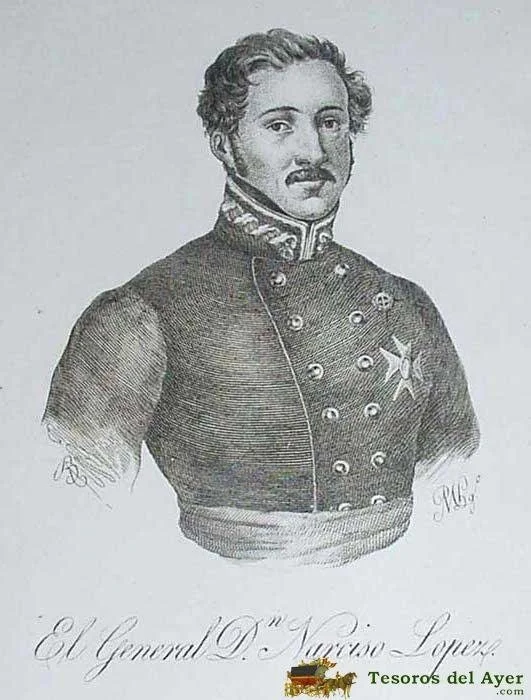
“Narciso López.” Public domain, via Wikimedia Commons.
The path that brought Guion to the governorship of Mississippi was shaped by both international intrigue and the state’s constitutional structure. The crisis emerged from a failed effort by American expansionists to seize Cuba, led by Narciso López, a Venezuelan-born adventurer who organized private military expeditions from the United States in hopes of liberating Cuba from Spain and bringing it into the Union as a slaveholding territory. Among his most prominent American supporters was John Anthony Quitman, then governor of Mississippi, who assisted in organizing men, funding, and planning for the invasion and was expected to play a leading role. Federal authorities, enforcing neutrality laws, moved against the conspiracy in 1850–1851, and indictments followed that reached into Mississippi’s highest ranks. Those implicated included former U.S. Senator John Henderson and Cotesworth Pinckney Smith, an associate justice of the Mississippi Supreme Court. Under mounting legal and political pressure, Quitman resigned the governorship on February 3, 1851, abruptly creating a vacancy at the top of state government.
At the time, Mississippi operated under the Constitution of 1832, which provided no lieutenant governor. Instead, the line of succession passed through the legislature. Guion had already emerged as a respected leader within that body; during the legislative session of 1850 he was elected president pro tempore of the Senate, in part because the sitting officeholder, Dr. Dabney Lipscomb from Columbus, was seriously ill and unable to serve in an active capacity.
Thus, when Quitman stepped down amid the fallout from the Cuba filibustering scandal, John Isaac Guion, by virtue of his position as president pro tempore, assumed the governorship ad interim, serving from February until November 1851. His elevation was not the result of a statewide election but of constitutional procedure during a moment of political disruption, placing him at the center of Mississippi’s government at a time when its leadership had been shaken by scandal and uncertainty.
He had already been elected to fill a circuit judgeship for Hinds County and when his state senate term ended that meant his time as governor ended and the state had to once again figure out who the governor was (another story for another day).
Do You Have More Information to Share?
Our historical research is never truly finished. Whether you have insights into our antique rose collection or stories of ancestors who rest here, your contribution helps Mississippi’s past come to life.
Alongside his professional and political ascent, Guion’s first marriage further anchored him within the most influential networks of the lower Mississippi Valley. Through his first wife, Lucinda Jane McCaleb of Claiborne County, he became connected to a family whose roots extended back to the earliest Anglo-American settlement of the Natchez District under Spanish rule. Her grandfather, William McCaleb, had served as a captain in the American Revolutionary Army, while her father, David William McCaleb, was a successful planter whose standing placed the family among the regional elite of Warren and Claiborne Counties. The broader McCaleb family network extended well beyond Mississippi. Her brother Thomas Farrar McCaleb possibly served as Secretary of State of Louisiana (some reports aren’t clear on this), her brother Theodore served for two decades as a federal judge in Louisiana, and her sister Mathilda married Mississippi Congressman William Hammett. Another brother, David McCaleb Jr., married the daughter of Joseph Davis, the older brother of Jefferson Davis, further extending these connections into one of the most prominent political families in the South. A final connection ties directly to Greenwood Cemetery: another sister, Martha, was the mother-in-law of William H. McCardle, the newspaper editor who co-authored a notably partisan history of Mississippi alongside former governor Robert Lowry (who has three daughters buried at GWC).
Guion’s second marriage to Cornelia Thankful Hicks further extended the family’s regional connections. Before marrying Guion, she had been the wife of Edward Dickson Hicks, with whom she had two children, including Emma Elizabeth Mims. Emma later married Livingston Mims, who would become mayor of Atlanta, linking the Guion family to civic leadership beyond Mississippi. Yet these connections remained rooted in Mississippi: Emma is buried in Greenwood Cemetery alongside her infant son Livingston, near Guion himself, reflecting how these blended family lines retained strong ties to the state even as they extended outward across the South.
From this second marriage came three children, all of whom eventually left Mississippi. Two—daughter Irene and son John Isaac Guion Jr.—settled in Runnels County, Texas. While little is known about Irene, her brother briefly achieved local prominence. Following his father’s path, John Isaac Guion Jr. studied law at Cumberland Law School in Lebanon, Tennessee. He later settled in Runnels County, where he was elected county judge during the county’s early years of organization. Named for former Mississippi governor Hiram G. Runnels, the county represented the westward extension of Southern settlement patterns into Texas. In his role as county judge, Guion Jr. would have presided over both administrative and limited judicial matters at the local level. His service, however, was brief; he did not favor the position and soon returned to private law practice.
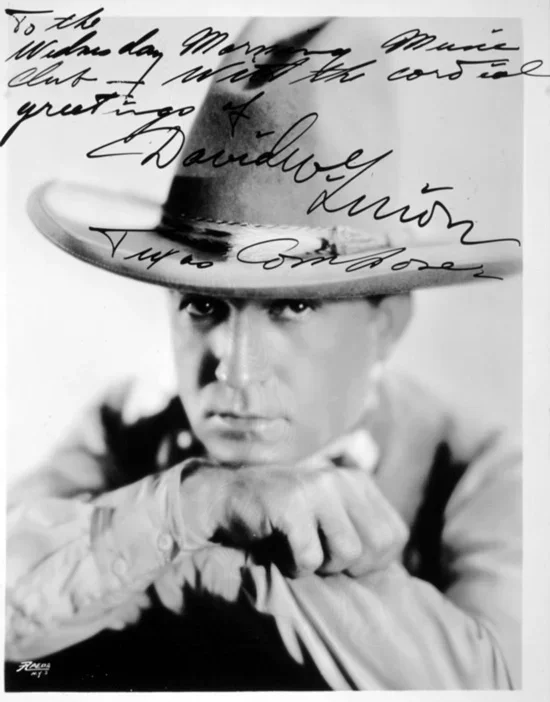
“David Wendell Guion.” Public domain, via Wikimedia Commons.
The legacy of the Guion family did not end with politics or law, but extended into the cultural life of the American South and beyond. In a later generation, that legacy found expression in the work of David Wendell Guion, who was born in Ballinger, Texas, into the extended Guion family. Trained as a pianist and composer, he gained recognition for his arrangements of American folk songs, particularly those rooted in the Western and Southern traditions that shaped his early life. His best-known work, an arrangement of “Home on the Range,” helped elevate a regional folk tune into the national consciousness and reflected a broader effort to define a distinctly American musical voice.
Taken together, the arc of the Guion family reflects a broader Southern story unfolding across generations. In the antebellum era, figures such as John Isaac Guion were shaped by politics, law, and sectional conflict, rising to positions of leadership in moments of instability. In the next generation, men like John Isaac Guion Jr. carried that commitment to public service into new geographic settings, helping to establish civic institutions in the developing regions of the postwar South. By the late nineteenth and early twentieth centuries, David Wendell Guion translated that inherited sense of place into cultural expression, preserving the sounds and stories of the region through music. From the halls of government to the courts of a frontier county and ultimately to the concert stage, the Guion family’s story traces a progression from political influence to civic leadership and finally to cultural contribution—each generation reflecting the evolving character of the American South.