Physician, Soldier, Statesman: The Story of Erasmus Burt
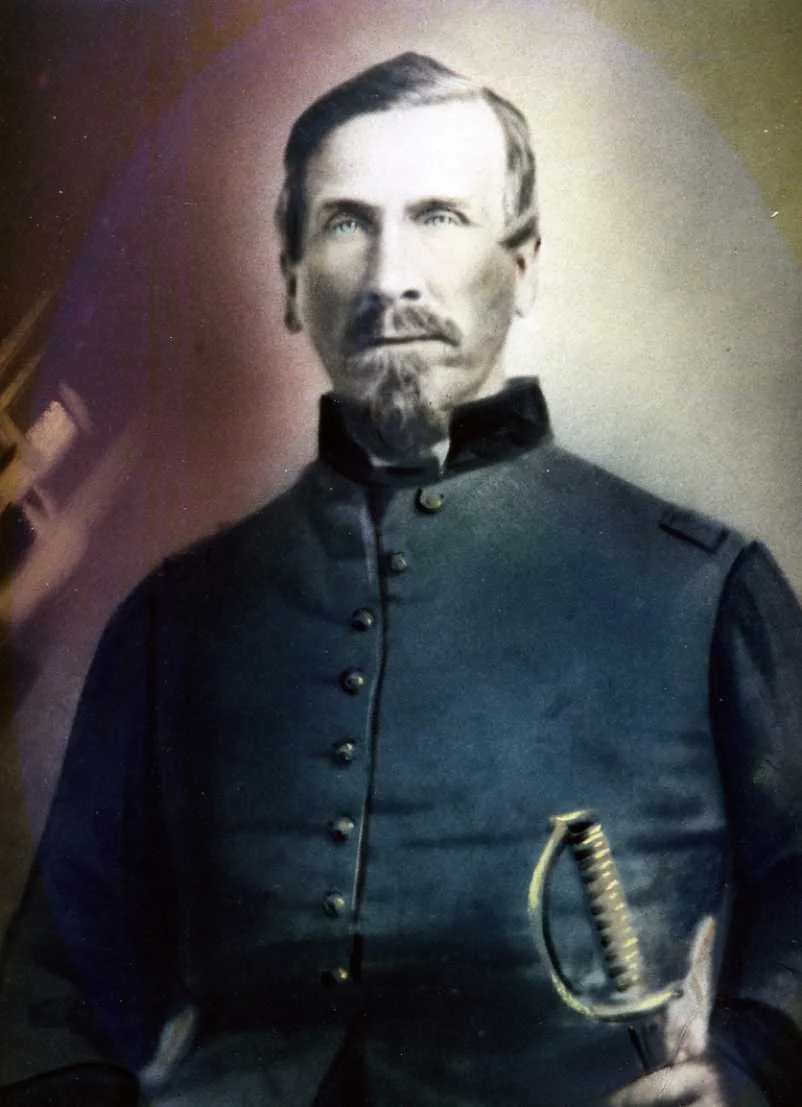
Photo is taken from Colonel Burt’s Find A Grave profile and submitted by one of his deceased descendants.
(NOTE: This article was first published in Mississippi Magazine’s December 2011 edition and written by Forrest Lamar Cooper and reprinted with his permission. Mississippi Supreme Court Chief Justice Tim Cooper is one of many judges and justices buried at Greenwood and is a relative of Forrest. The additional notes and information at the end of the article was compiled by Nick Walters.)
Colonel Erasmus R. Burt, the commanding officer of the 18th Regiment of Mississippi volunteers, was mortally wounded at the Battle of Leesburg on October 21, 1861. He was the first field officer from Mississippi to fall in battle during the War Between the States.
The North’s second invasion into Virginia occurred October 21, 1861, four miles northeast of Leesburg, Virginia, atop a 100-foot overlook above the Potomac River, on land that once belonged to the family of Mary Ball Washington, George Washington’s mother. The fog was thick as broth, and the lulling quiet of early morning silence veiled the presence of the two determined and stealthy armies preparing to face one other with rifled muskets fitted with glistening bayonets. After clearing for 12 ferocious hours, the fog rolled in again. It fell breathlessly silent, shrouding the bodies of the dead in what has become known as the massacre at Ball’s Bluff or as it is known in Southern history, the Battle of Leesburg. The topography of this land—the steep sloping bluff, laurel thickets, vines, outcroppings of sandstone, and large trees—played an important role in this defeat of Lincoln’s army.
Follow us on Facebook and Instagram
The Confederate volunteer defenders, almost none of whom were professional soldiers, fought not as aggressors or in a spirit of conquest, but in response to a call to defend their homeland, the Confederate State of America, from an unjust invasion. Most of the all-day battle took place on the top of the bluff, in and around a relatively level 12-acre grassy area. It was in this wide-open meadow that, at 2:30 p.m., Colonel Erasmus Burt, the commanding officer of the 18th Regiment of Mississippi Volunteers, obeyed the order to attack the left flank of the Federals.
Colonel Burt, a native of Edgefield County, South Carolina, had moved to Mississippi with his wife and their first two children in 1844, settling in Oktibbeha County. As a young physician, Dr. Burt is believed to have been one of three doctors practicing medicine in this area during the turbulent years preceding the War for Southern Independence. Political matters were very much at the forefront during this era, and, being civic minded, Burt threw his hat into the ring and was elected to the state legislature as the representative from Oktibbeha County. Although he only served one term (1854–1855), he was successful in introducing legislation that established the Mississippi Institution for the Deaf and Dumb. This became his legacy, and still today, he is looked upon as the father of this worthy institution. As the political storm clouds began to gather, Burt moved his family to the Jackson area, where, on April 9, 1860, he was elected captain of a militia unit known as the Mississippi Capital Dragoons. One year later, on April 22, 1861, the Dragoons were mustered into state service as Burt’s Rifles. Arriving in Corinth by train on April 26, the Rifles became Company D of the 18th Regiment, Mississippi Infantry, CSA, and Burt was elected their colonel.
True to the Public Trust Since 1823
From Pulitzer Prize winners to those who served from the War of 1812 through WWII, Greenwood is a chronicle of sacrifice and success. Help us fund the research, tours, and preservation efforts that bring this history to life. Join us in honoring the depth and complexity of the Mississippi story.
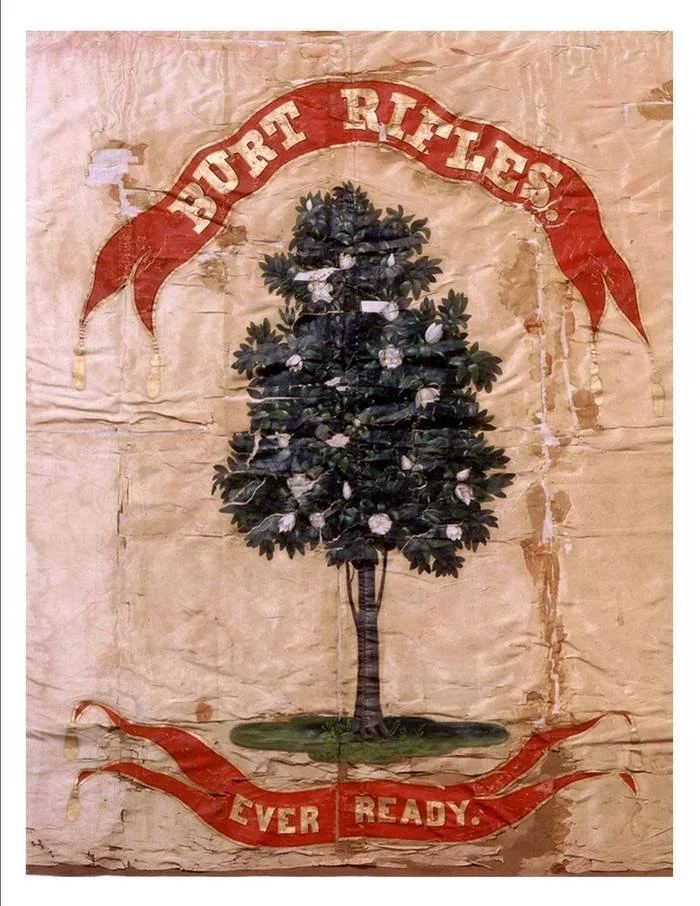
“Burt Rifles” flag, 18th Mississippi Infantry. Courtesy of the Mississippi Department of Archives and History, Museum Division.
Historian James M. Morgan III noted Burt’s charge at Leesburg in his book, A Little Short of Boats: The Battles of Ball’s Bluff and Edwards Ferry: “Burt could not see [the English-born] Colonel [Edward] Baker’s northern (right) wing manned mostly by the 15th Massachusetts just inside the woods where the ground dropped off enough to provide cover.”
When Burt and his men reached a point within a hundred yards of the Federal position, they received what private Elijah White called “the best directed and most destructive single volley” he witnessed during the entire war. The action stopped the assault in its tracks, and of the 85 members of the 18th Mississippi (including Colonel Burt himself) who were killed or wounded during this battle, “a very large majority fell at this one fire.” Private White, who near the war’s end became a lieutenant colonel in command of the 35th Battalion of Virginia Cavalry, reflected on the mortal wounding of Colonel Burt: “[He] was riding close up to his regiment in rear of the line, and I rode beside him on his right.” The regimental surgeon described the injury: “the ball [believed to be a .58 caliber] went in above the hip joint and entered the cavity…passing through the hip bone.” Private White ended his written report with, “He [Col. Burt] turned to me and, in a tone as calm as if in ordinary talk, said, ‘Go tell Colonel Jenifer I am wounded and shall have to leave the field.’”
Before the day ended, the 18th Regiment regrouped and, along with the 17th Mississippi Regiment and the 8th Virginia, mounted an offensive that culminated in the rout of the Union army. The final assault, with both sides running low on ammunition, consisted of Rebel yells and a fierce bayonet charge that threw the Union fighters into a panic, and as many as 1,200 or 1,300 of them broke and ran for their lives. During the last minutes, some men plummeted down the bluff to their deaths, while others ran south of the cliff into a ravine, tossing their weapons aside in a frantic effort to reach the river. By the time darkness arrived, Colonel Burt had been taken by wagon to a large brick home called Harrison Hall, on Leesburg’s King Street, where he died five days later, on October 26, 1861.
Do You Have More Information to Share?
Our historical research is never truly finished. Whether you have insights into our antique rose collection or stories of ancestors who rest here, your contribution helps Mississippi’s past come to life.
Jackson historian Peter B. Miazza has diligently researched genealogical work entitled Colonel Erasmus R. Burt and offers this word picture of what happened the morning after the colonel’s death: “The 17th and 18th Mississippi Infantry Regiments, along with South Carolina’s 5th, sections of the Washington Artillery, and a company of Virginia Cavalry, marched into Leesburg for services for Colonel Burt.” At the close of the ceremonies, Mississippi’s Colonel William Barksdale, who later was killed leading a charge at Gettysburg, led the procession—a somber scene of a slow military march to the cadence of the dirge “Lilly Dale,” staunchly performed by a regimental band—to the train that was to carry his remains home to Jackson.
In a letter dated November 4, 1861, to his wife in Natchez, State Representative Joseph Dunbar Shields wrote, “The funeral obsequies of Colonel Burt will be celebrated today. He left a wife and eight children in very cramped circumstances. The last time I saw him he was in the full vigor of manhood, but now alas his corpse lies in the dome of the Capitol within fifty feet of the spot where I parted from him.” In his next correspondence, dated two days after Colonel Burt’s body had been buried in Jackson’s Greenwood Cemetery, he wrote that the funeral had been “a grand and moving spectacle,” and “when they were lowering the coffin, the plaintive wail of Burt’s afflicted widow moved us all to tears.”
As the years passed into decades, Colonel Burt’s grave, near the northeast corner of Greenwood Cemetery in Jackson, remained unmarked. This was not an oversight. It was a reflection of the bleak economic times that plagued much of the state and indeed the entire South for half a century following the war.
On October 21, 1910, 49 years to the day after Colonel Burt received his mortal wound, a modest tombstone, donated by veterans of the war, was erected over his grave. The R.S. Smith Camp of Confederate veterans along with three other patriotic organizations including the United Spanish-American War Veterans, were joined by a sparse grey line of veterans, family members, and other interested citizens in the late afternoon sun to hear five speakers and a double-quartet from Millsaps College pay tribute to the gallant Mississippi officer who followed his heart and who believed in the words of his commanding officer, General Robert E. Lee, who said, “Do your duty, in all things. You cannot do more, you should never wish to do less.”
UPDATED NOTES: Colonel Burt was one of five brothers (there were no sisters) and each were accomplished in their own way.
His first brother was Armistead Burt who was a United States Congressman from South Carolina and served in the SC Legislature before being elected to Congress. He served five terms in the US House, was Speaker Pro Tem, Chairman of the Military Affairs Committee and was married to John C. Calhoun’s niece.
Like Erasmus, two of his brothers were physicians. One practiced in Jacksonville, Alabama and the other in Millville, Texas, which is just south of Longview.
The fourth brother, Francis, took the same path has the oldest brother Armistead and served in the South Carolina legislature. His greater claim to fame was being appointed by President Franklin Pierce as the first governor of the Nebraska Territory in 1854. The Kansas-Nebraska Act was a large part of the build up of the Civil War (it was the keystone of the Lincoln-Douglass debates) and unfortunately brother Francis passed away just a few months after arriving in the territory. Burt County, Nebraska is named for him.
Erasmus’s son Francis was killed at the Battle of Kennesaw Mountain in Georgia.