At His Post Until the End: Rev. Amos Cleaver and the Yellow Fever of 1853
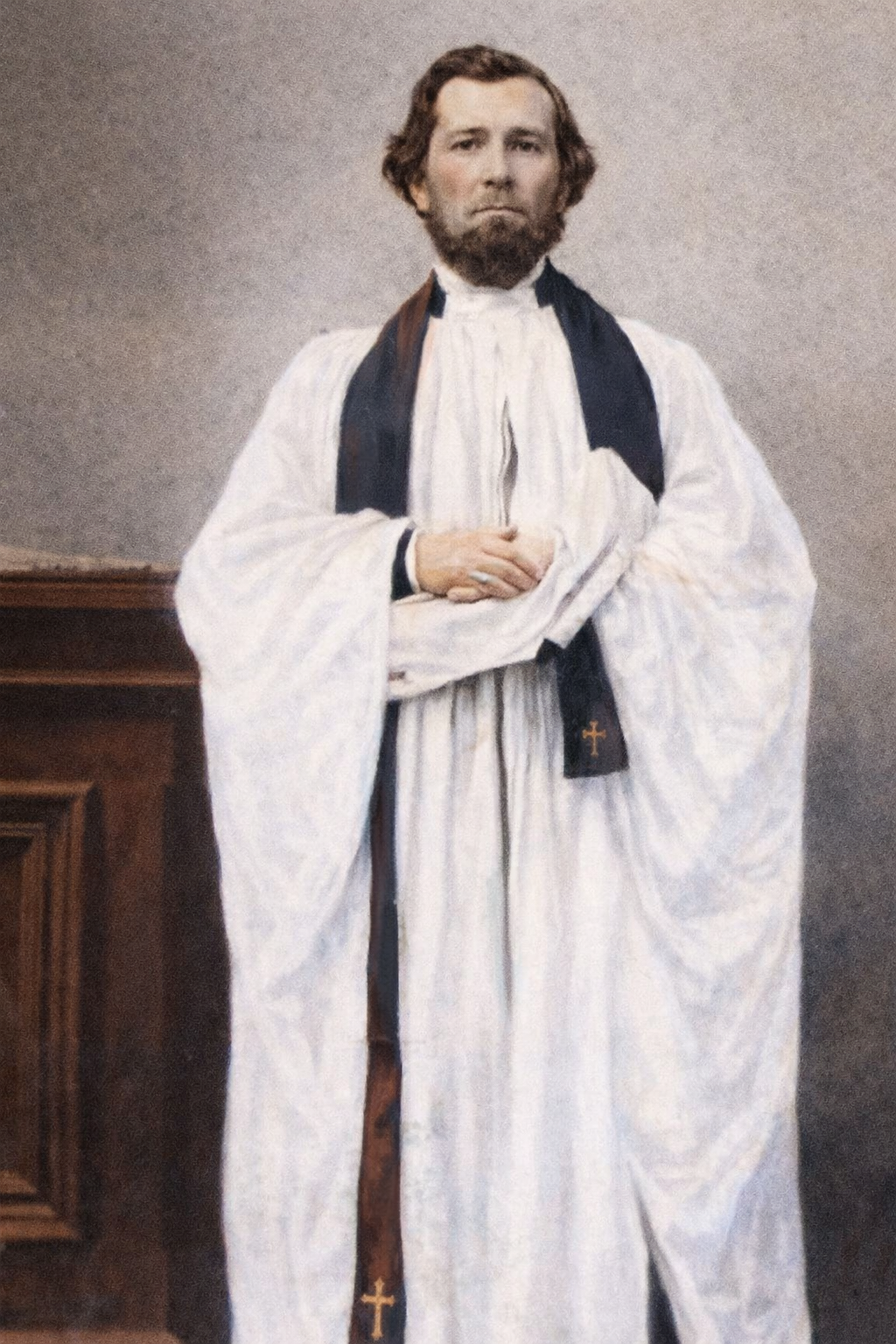
Rev. Amos Cleaver. Original image published in Peter Miazza, Voices Heard from the Grave: Greenwood Cemetery, Jackson, Mississippi. This version has been digitally enhanced and colorized using AI for presentation purposes.
On August 12, 1830, a gentleman disembarked from the ship Symmetry at Philadelphia, Pennsylvania. He sailed from Liverpool and was thirty years of age. His name was listed as Amos (sic) Cleaver. He was a cabin passenger which would indicate that he possessed some means.
His odyssey in America began with Lexington, Kentucky. On Sunday the 28th of November, 1830, he was ordained as a deacon in the Virginia Diocese of the Protestant Episcopal Church by the Rt. Rev. Bishop Richard Channing Moore. Cleaver then moved to Lexington, Kentucky. The next year, 1831, the Rt. Rev. Bishop Benjamin Bosworth Smith assigned him to the town of Versailles which was about thirteen miles west of Lexington. Although the church was not begun in Versailles until 1847, Cleaver is recognized as the first Episcopal clergyman to have officiated in that town. No record has been found to indicate when and where he was ordained as a priest but it must have been soon after he became a deacon. In 1832 he was sent to Paris, Kentucky which is located about eighteen miles northeast of Lexington.
Follow us on Facebook and Instagram
Cleaver officiated at services held in the Bourbon County courthouse in Paris until the weather turned cold in the winter. Because it was so difficult to heat the courthouse, they met in a rented house. The next year a church building was begun on High Street across from the courthouse. It was consecrated on February 24, 1834. Rev. Amos Cleaver was named as one of the trustees.
In 1820 the General Convention of the Episcopal Church had created the Protestant Episcopal Missionary Society of the United States for Foreign and Domestic Missions. The society met in Philadelphia for the next fourteen years before relocating to New York City. In 1835 the society underwrote three missionaries in Kentucky, one of whom was Cleaver. They each received a stipend of $250 annually. The funds were quite welcome since a shortage of funds was often included in the reports of the various churches in Kentucky.
At the eighth convention of the Kentucky Diocese held in Louisville in June, 1836 Cleaver reported that he held services twice a month in Paris and at the event of spring, also held services on the outskirts of the county. During the past winter he felt that it was not prudent for him to go into the country to hold services since he would be riding in the dark on bad roads over which he was not familiar. Cleaver also reported that the church edifice, which was started in 1833, was still not finished. He wrote that attendance in the country was much better than in Paris because there were five churches in Paris for 1500 members while he was the only one serving the countryside.
True to the Public Trust Since 1823
From Pulitzer Prize winners to those who served from the War of 1812 through WWII, Greenwood is a chronicle of sacrifice and success. Help us fund the research, tours, and preservation efforts that bring this history to life. Join us in honoring the depth and complexity of the Mississippi story.
The next year, 1837, Cleaver served in Paris every Sunday morning and then in the afternoon at St. Mark’s Parish near Millersburg which was six or seven miles from Paris. He also officiated at another place about four miles from Paris towards Lexington. By June the church at Paris was finished and ready to be occupied. Cleaver had the church out of debt. It was also built without going into debt. In September, 1838 the church contributed eight dollars and fifty cents to the American Colonization Society. Rev. Cleaver established a school in Paris which led him to resign as the rector of St. Peter’s in 1838. The missionary society accepted his resignation in October of that year. He was followed by F. B. Nash who had recently been ordained. Cleaver, however, continued to substitute every other Sunday for the rector at Leesburg. When Rev. Nash was reassigned to Hopkinsville, Cleaver was elected to be his replacement at St. Peter’s and he accepted. He continued to go to Leesburg one Sunday each month until bad weather precluded him from traveling. When the diocese held its convention May 12, 1842, Cleaver sent his regrets that he was unable to attend due to illness. The school was important to him because it was the main support for his family. The 1840 census does not show that he had any children, nor did he have any when he died. Only he and his wife Maria were enumerated in the census. She was a native of Maryland, but when and where they were married is unknown.
In October of 1842 Rev. Cleaver once again resigned as rector of St. Peter’s because his other duties were too oppressive. However, when no replacement arrived, he continued to act as rector until August, 1843 when J. A. Shepherd took over. When the 1844 diocese convention was held, Cleaver was living in Louisville where he was teaching at a “Young Ladies’ School.” He submitted a claim to the diocese for missionary services.
During the summer of 1848 Cleaver made a visit to Baltimore where he officiated about three Sundays each month. The reason for the trip is unknown, but his wife Maria being from Maryland could have been the reason. He returned home about the middle of September and announced that the next session of his school would be held from October 2nd until June. In November he accepted a missionary appointment to serve St. Luke’s parish in the community of Brandon. They had to share a building with other denominations, so he could only preach every third Sunday of the month. The other three Sundays he was to be at the penitentiary.
Cleaver continued to serve St. Luke’s parish and in 1850 was elected as the chaplain for the State Penitentiary. He wrote, “This is a most interesting field of labor, the church service is well adapted to the condition of the convicts, and to see them worshipping and hear them responding, far they respond excellently, is most gratifying and delightful.” There is no record of how long Cleaver continued with both of these efforts, but in 1852, he was listed as the only one in the Protestant Episcopal Quarterly Review and Church Register, Vol. I, as still the chaplain of the State Penitentiary when he died.
Cleaver’s “Select School for Young Ladies” continued to educate some of Jackson’s young ladies for the next few years. On March 28, 1851, a lot was purchased for twelve hundred dollars from Joseph W. Miller and his wife Martha Ann and on April 17th mortgaged it to Daniel Adams for eleven hundred and fifty dollars. When the school session ended on February 18, 1853, Cleaver sent to the patrons of his school the scholarship and behavior grades of his eighteen students. They were only identified by letter A to Q and their grades ranged from 100 to 94. He gave a statement to Richard M. Hobson for seventeen weeks of instruction of his two daughters, Catherine and Emma. Catherine’s grades were identified by the letter A and Emma’s by J. There was a balance owed of $121.88.
Do You Have More Information to Share?
Our historical research is never truly finished. Whether you have insights into our antique rose collection or stories of ancestors who rest here, your contribution helps Mississippi’s past come to life.
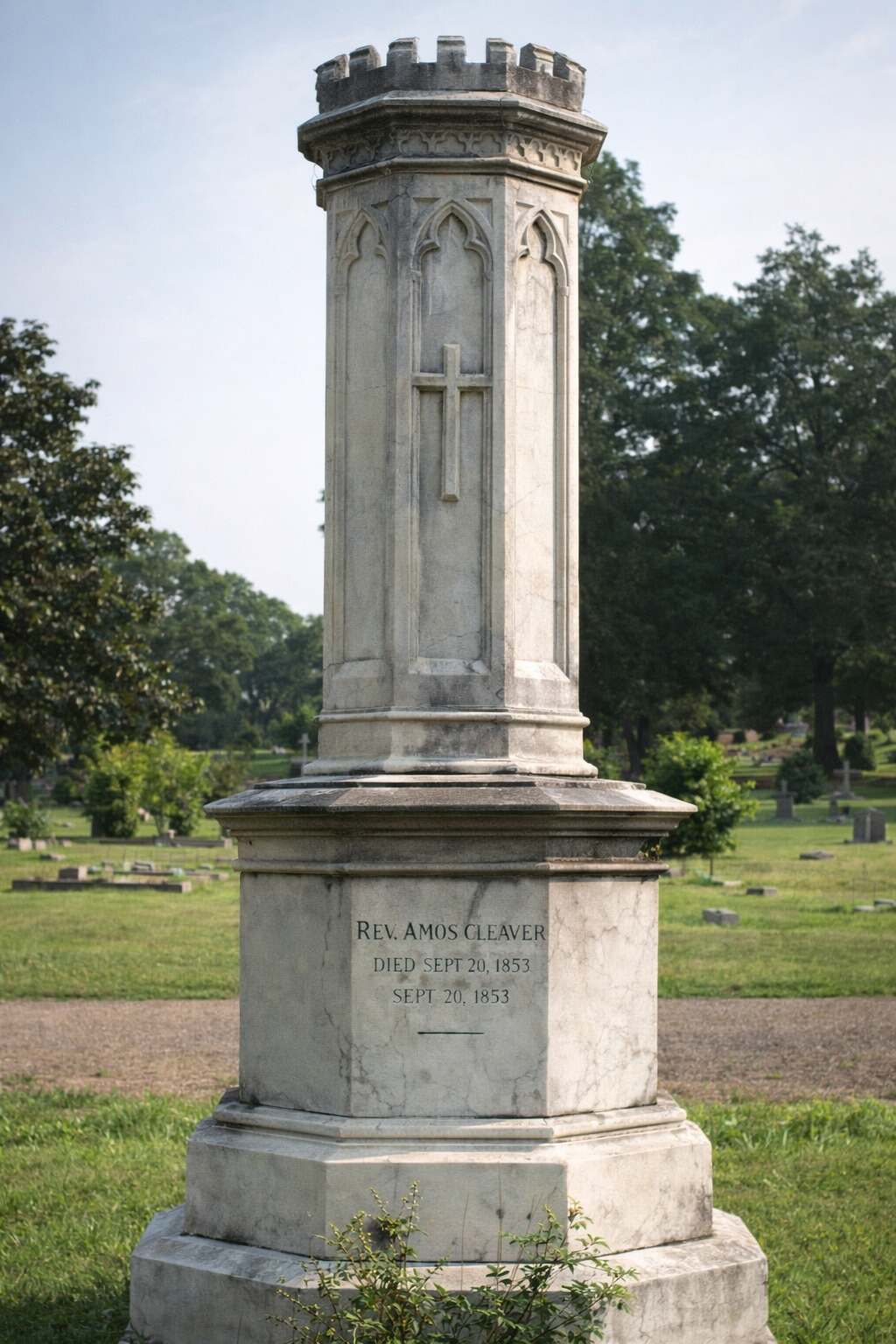
Rev. Amos Cleaver monument inside “the circle” at Greenwood Cemetery. AI used to enhance the clarity of the photograph.
In 1853 the dreadful scourge Yellow Fever broke out in New Orleans. Putting commercial and financial interests ahead of the citizens’ well being, city leaders downplayed the severity of the epidemic. Eventually it moved up the Mississippi River town by town until it reached Vicksburg. There the same attitude prevailed. During October a carpenter working in Vicksburg for a few days then returned home to Jackson. Unfortunately, he introduced Yellow Fever to Jackson. The disease soon claimed one of its earliest victims, Rev. Amos Cleaver. He succumbed on October 17, 1853, and was buried in Greenwood Cemetery.
A few years later some of the ladies in the city had a fundraising dinner on December 30, 1858, for the purpose of erecting a monument to Rev. Cleaver. A tract was given to the ladies by brothers to carve out the place for the monument in the key section of the cemetery where the two main drives intersect. When the charter and revised ordinances of the City of Jackson were adopted July 1, 1867, it contained an ordinance that specified, “That the centre circle or lot of ground in the new City Cemetery in which the remains of the late Rev. Amos Cleaver are buried, be, and the same is hereby reserved for the purpose of the interment of the said Rev. Amos Cleaver.” The ordinance erred in saying that Cleaver was buried in the circle. He died before the new section of the cemetery opened, and, as happened with numerous others, the location of his grave was lost. When John Logan Power conducted his 1860 inventory of existing markers in the cemetery, he did not find one for Cleaver.
On February 24, 1854 the legislature finally enacted a bill for the relief of the blind and dumb children of Mississippi. The newly appointed trustees did not have to search long for a place to locate the school. Since his death, Cleaver’s school on West Street stood empty of students. Maria Cleaver was approached about selling the property but she wanted ten thousand dollars for it. She finally agreed to accept nine thousand for it with the other thousand being a donation. The citizens of Jackson then paid two hundred dollars, the city raised five hundred, and the legislature appropriated an additional fifteen hundred dollars. The deed was completed on April 15, 1854, in time for the new school to open in August. Part of the sale price went to clear the mortgage held by Daniel Adams.
The settlement of Cleaver’s estate was delayed until December. The delay was probably to ensure that the Yellow Fever epidemic was over before taking inventory of the estate. She said that Cleaver was childless and had no known living relatives other than herself. She estimated the value of the estate to be three or four thousand dollars. The court appointed John T. Hull, James Black, and Richard M. Hobson to inventory his personal possessions. As expected, the inventory included mostly items that were needed to furnish a boarding school and were valued at $1,300.00 and a female slave Aggy valued at $900. The total was $3,358.50. On December 13, 1854, the court summoned her to give an account of the estate but she failed to appear. She was again summoned on January 8, 1855, and again failed to appear. The summons was repeated on April 7, 1855, with the same results. Finally, on the 14th of May the court ordered her to be arrested and brought before the court. She was not found and by 1855 the court had been unable to find her anywhere in the county.
The last known record of Maria Cleaver was on May 31, 1854, when the Protestant Episcopal Society for Diffusing Christian Knowledge in the Diocese of Mississippi listed her as an annual and occasional contributor. No further record of Maria Cleaver has ever been found.