A Church, an Epidemic, and the Legacy of Thomas and Mary Helm
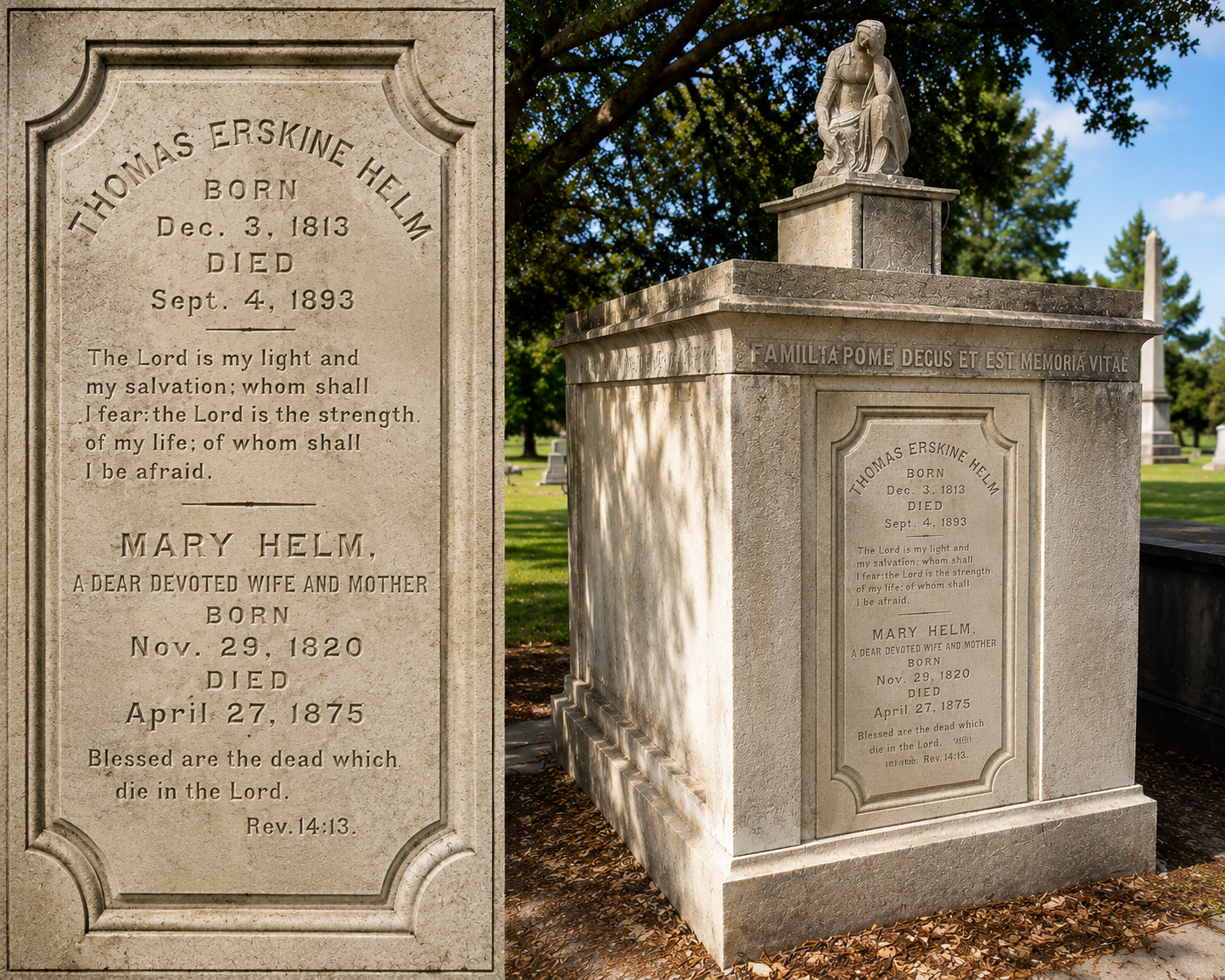
Thomas and Mary Helm Mausoleum, Greenwood Cemetery, Jackson, Mississippi. AI-generated reconstruction based on contemporary photographs. Original photographs courtesy of Greenwood Cemetery.
During Greenwood Cemetery's recent participation in the national 48 State Tour, organized locally by Old River Cemetery Restoration, visitors gathered among some of Jackson's oldest monuments to learn proper cemetery preservation techniques. One of the projects undertaken during the event involved a broken stone urn resting on the grave of Thomas Helm, the son of Thomas and Mary Helm. An Atlas Preservation representative carefully repaired the damaged urn, ensuring that another piece of the family's story would survive for future generations.
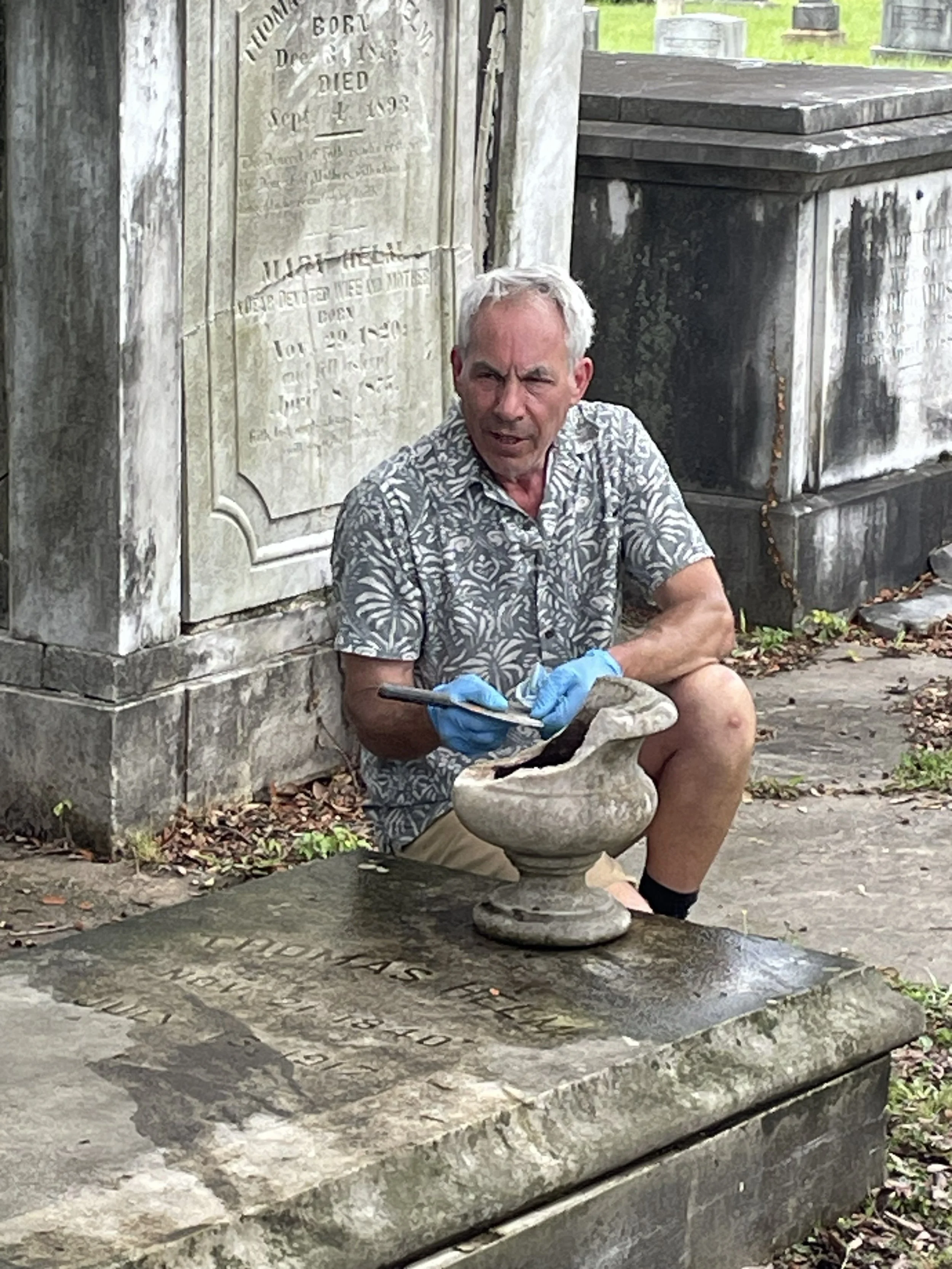
An Atlas Preservation restoration educator demonstrating techniques at Greenwood Cemetery June 17, 2026. Photo by author.
It was a fitting moment. For while the urn belonged to a son, the story ultimately leads back to two parents whose influence can still be seen throughout Jackson more than a century after their deaths.
Follow us on Facebook and Instagram
Thomas Erskine Helm was born in Woodford County, Kentucky, on December 3, 1813, and was educated at Transylvania College in Lexington. Seeking opportunity in the growing Southwest, he arrived in Mississippi in 1833 and spent nearly two decades in the Natchez region engaged in planting and agricultural pursuits. Although he accumulated considerable property during those years, much of it was eventually lost. Seeking new opportunities, he relocated to Jackson in the early 1850s, where he turned increasingly toward banking, real estate, and other business ventures.
The move proved successful. Helm eventually became president of Capital State Bank and emerged as one of Jackson's leading businessmen. Even after selling the bank in 1885, he remained a stockholder and served as its vice president. Through banking, real estate investments, and other enterprises, he established himself as an important figure in the civic and financial life of the capital city.
His wife, Mary Biggs Helm, came from one of the Natchez region's established families. Born near Natchez in 1820, she was the daughter of Colonel William Biggs of Adams County. Thomas and Mary married in 1836 and built a life together that would span nearly four decades. They experienced both prosperity and profound sorrow. Of their nine children, six died before Mary herself passed away in 1875.
Mary's obituary paints the portrait of a woman remembered for her kindness, faith, and devotion to family. Friends described her as possessing a "winning gentleness" and an "earnest simplicity" that made her a beloved friend and neighbor. The obituary called her "the light of her home, the centre and source of all its joy." Repeated family tragedies deepened rather than weakened her faith, and those who knew her remembered a woman whose trust in God remained steadfast through every sorrow.
True to the Public Trust Since 1823
From Pulitzer Prize winners to those who served from the War of 1812 through WWII, Greenwood is a chronicle of sacrifice and success. Help us fund the research, tours, and preservation efforts that bring this history to life. Join us in honoring the depth and complexity of the Mississippi story.
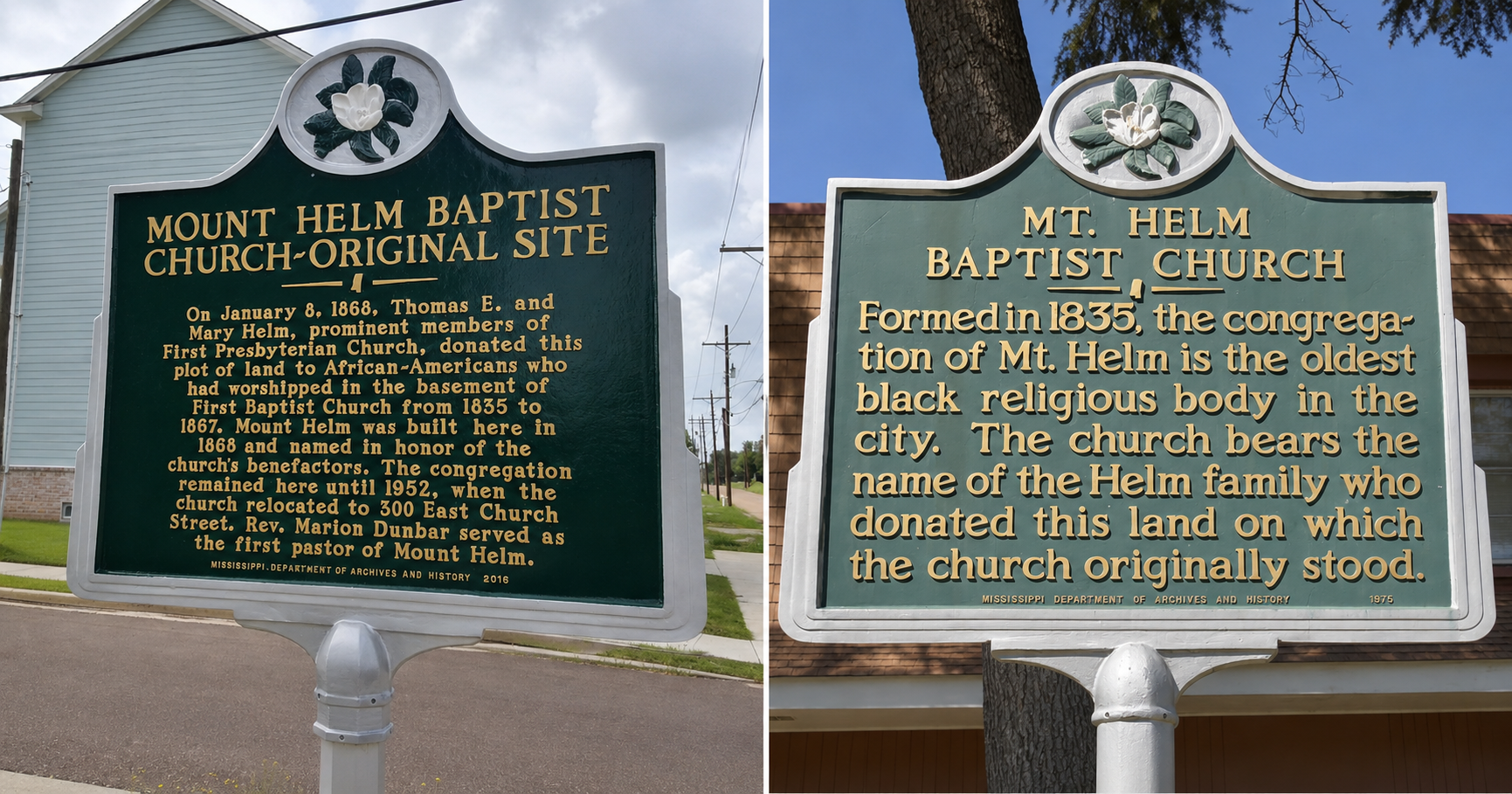
Mt. Helm Baptist Church historical markers, Jackson, Mississippi. Photographs by Mark Hilton, March 22, 2018. Courtesy of the Historical Marker Database (HMdb.org), including Photo ID 389820. Composite image created from the original photographs.
The legacy of Thomas and Mary Helm extends far beyond their family. In 1868, the Helms donated land and financial assistance to a newly organized African American Baptist congregation in Jackson. Formerly enslaved members had worshipped for years in the basement of First Baptist Church. Following emancipation, they sought a permanent home of their own.
The gift from Thomas and Mary Helm helped make that dream possible.
In gratitude, the congregation named the church Mount Helm Baptist Church. The church would become one of the most important institutions in Jackson's Black community. Its first pastor was Rev. Marion Dunbar, who is also buried at Greenwood Cemetery and was the subject of a previous "Gone But Not Forgotten" feature. Early classes associated with Jackson College, the institution that would eventually become Jackson State University, were held at Mt. Helm. Today, historical markers commemorate both the church and its original location, preserving the memory of the couple whose generosity helped make its founding possible.
Mary died in April 1875 and was laid to rest in Greenwood Cemetery. Thomas, however, remained deeply involved in the civic and business affairs of the city.
Do You Have More Information to Share?
Our historical research is never truly finished. Whether you have insights into our antique rose collection or stories of ancestors who rest here, your contribution helps Mississippi’s past come to life.
Three years later, Mississippi faced one of the greatest public health disasters in its history.
The Yellow Fever Epidemic of 1878 swept across the state, killing thousands. Modern medicine had not yet discovered that mosquitoes carried the disease. Physicians understood the symptoms—high fever, jaundice, hemorrhaging, and the dreaded "black vomit"—but they did not understand its cause. Many believed yellow fever spread through foul air, unhealthy environmental conditions, or direct exposure to infected individuals. As fear spread across Mississippi, those who could afford to leave often fled to the countryside, convinced that fresh air offered protection from the disease.
People left Jackson and other Mississippi communities as quickly as they could.
Thomas Helm stayed.
At the time, Helm owned and operated Capital State Bank. Rather than close its doors and leave town, he continued to keep the bank open throughout the epidemic. According to his obituary, he personally served as cashier and teller while many other prominent citizens departed. During the crisis, he reportedly handled more than $100,000 in exchanges without charging a discount fee.
His decision was not simply a matter of business.
People still needed access to their money. Families needed cash to travel, purchase supplies, care for sick relatives, and survive a period when commerce throughout Mississippi was grinding to a halt. By keeping the bank operating, Helm provided an essential service at a time of uncertainty and fear.
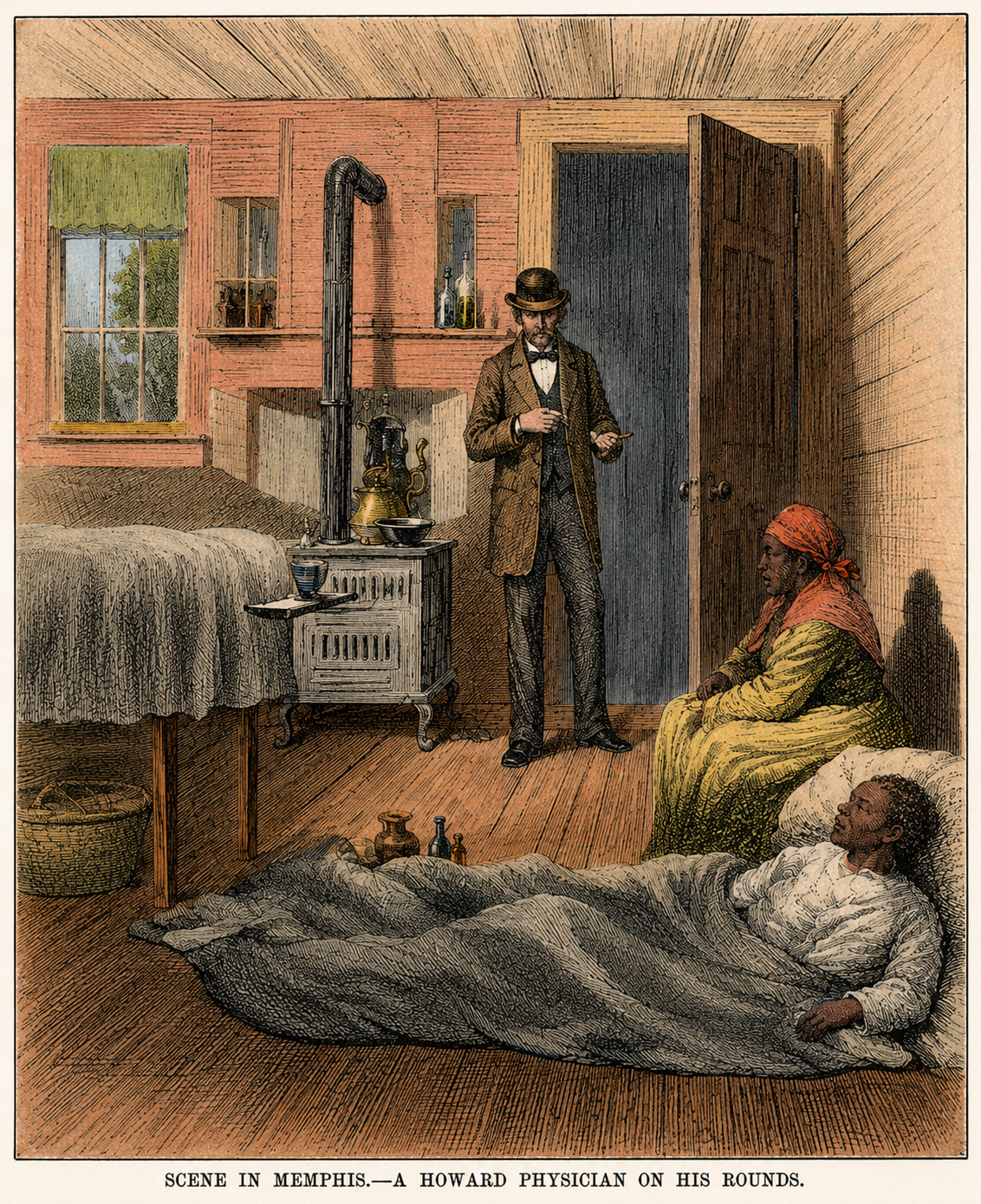
"Howard physician on his rounds in Memphis." Digital Public Library of America, https://dp.la/item/22d74a981c0017941ccc68bb1f8369d2. Image digitally cleaned and color-enhanced using artificial intelligence from the original historical illustration.
He also became active in the Howard Association, one of the most important relief organizations of the nineteenth century. The original Howard Association was founded in New Orleans in 1837 and was named for English prison and hospital reformer John Howard. Created in response to recurring yellow fever outbreaks along the Gulf Coast, the organization relied on volunteers rather than government funding and quickly developed a reputation for courage during epidemics. As yellow fever spread throughout the Mississippi Valley, Howard Associations were organized in communities across the South to provide emergency assistance when local governments lacked the resources to respond effectively.
During epidemics, Howard Association volunteers recruited physicians and nurses, raised relief funds, distributed food and medicine, cared for orphaned children, and assisted families whose lives had been disrupted by disease. In many communities, they functioned as the nineteenth-century equivalent of a public health department, disaster-relief agency, and charitable organization combined. Before modern emergency management systems existed, organizations such as the Howard Association often became the primary source of aid for frightened communities struggling to cope with crisis.
Helm did more than lend his name to the effort. He remained in Jackson during the epidemic, actively participated in the work of the Howard Association, and personally contributed five hundred dollars to local relief efforts. At a time when many citizens were leaving town, he chose to stay and serve.
When Thomas Helm died in September 1893, tributes came from many corners of Jackson society. His obituary praised his generosity, business acumen, and public spirit. Yet one of the most remarkable memorials occurred at Mt. Helm Baptist Church.
The congregation held a special service in his honor and remembered him as "a friend, a Christian and a benefactor." The gratitude expressed that day reflected not only Thomas's life of service but also the earlier generosity of both Thomas and Mary Helm, whose gifts had helped establish the congregation a quarter-century earlier. Among those participating in the memorial service was J. L. Power, who had worked alongside Helm in the Howard Association during the Yellow Fever Epidemic. Power, who later served as Mississippi Secretary of State, is also buried at Greenwood Cemetery.
Today, Thomas and Mary Helm rest together beneath one of Greenwood Cemetery's most distinctive mausoleums. Visitors often notice the monument's weathered beauty, but the true legacy of the Helms extends far beyond stone and marble.
Their story reaches into the history of Mt. Helm Baptist Church, the origins of Jackson State University, the relief efforts of the Yellow Fever Epidemic, and the civic development of Mississippi's capital city. More than 130 years after their deaths, preservationists are still caring for the Helm family's monuments. The repair of a broken urn on the grave of one of their sons during Greenwood Cemetery's recent preservation workshop serves as a reminder that stewardship is about more than stone and mortar. It is about remembering the people whose lives helped shape a community.
Thanks to the efforts of Old River Cemetery Restoration and the many volunteers who devote their time to preserving historic burial grounds, the stories of Thomas and Mary Helm continue to be shared with new generations.
Gone, but not forgotten.
