AUNT NANCY HILL
By Linda Thompson Robertson
It has been said that the brilliant inventor Thomas Edison (1847-1931) dreamed of developing a “spirit phone” that could record the voices of the dead. I wish there were such a device – I’d take it to Greenwood Cemetery to locate the grave of Aunt Nancy Hill (1846-1929), a veritable street angel who cared for Jackson’s unwanted children and babies.
Aunt Nancy Hill was a well-known and well-loved character about Jackson in the late 19th and early part of the 20th century. Her real name was Nancy Thomas Hill, but she had a most peculiar nickname – one that newspapers spelled with several variations – Aunt Nancy JULESPICE (Christmas spice?) (the version that appeared in her Clarion-Ledger obituary in 1929), JUICESPICE or JUICESPICY (early newspapers articles written during her lifetime), or (in more modern accounts, none of the earlier ones mentioning a pipe) JUICEPIPE.
Follow us on Facebook and Instagram
Newspaper reporters in her time claimed she didn’t like the “Aunt Nancy Juice-----“ nickname. She wanted to be called Mrs. Hill, her “proper name.” Hill was the surname of her husband Frank.
Nancy Thomas was born about 1846 in Alabama. Census records indicate Frank Hill may also have been an Alabamian, and maybe that was where they met. One newspaper account said Nancy lived most of her life in Jackson. She and Frank were here at least before the 1878 yellow fever epidemic. It was said Nancy Hill was not afraid to go into homes where parents had died of the fever to gather up living children and foster them until relatives could be found.
By 1900, Mrs. Hill told the census taker she was a widow, although the census reported Frank lived nearby but not in the same dwelling. On various records, she was listed as a cook or laundress and he, a laborer. Nancy and Frank had some children of their own, and she bragged to newspaper folks that she raised 108 in all.
An article in the Clarion-Ledger on January 4, 1908, reported that Nancy Hill had been seriously wounded in a hunting accident with a child and odds were against her survival. The reporter described her as a “Jackson celebrity in her sphere. She is personally known to all the older residents as a Good Samaritan, the mother of the fatherless and the protector of the orphan, whether white or black – the color of the skin making no difference to her, and it is said that she has raised more children and started them out in the world than any orphanage in the land.” The article ended with, “No doubt a crown of glory awaits her on the other side of the river.” A small bullet had gone in her back, through her lung, and lodged in her breast, but, attended by Dr. Harley Shands and a Dr. McLain, she lived to continue her good work.
True to the Public Trust Since 1823
From Pulitzer Prize winners to those who served from the War of 1812 through WWII, Greenwood is a chronicle of sacrifice and success. Help us fund the research, tours, and preservation efforts that bring this history to life. Join us in honoring the depth and complexity of the Mississippi story.
Mrs. Hill was also known as something of a clairvoyant with supernatural powers. She read palms and predicted the future, and people came to her for help finding all manner of lost articles, such as diamond rings or missing horses. She was a healer of babies, and older humans as well, and she was an animal whisperer who worked her talents to cure sick livestock. For many years in her later life she drove about south Jackson in a curious wooden sled behind a mule, gathering junk to sell.
She was a patriot. In anticipation of Armistice Day in November 1918, the old Jackson No. 1 Fire Company bell, vintage 1843, was brought to the front of the Old Capitol. About 3 o’clock the morning of November 11, before there was official word, Mrs. Hill was there pulling the bell rope and announcing that the boys were coming home. She continued to peal the bell all day long.
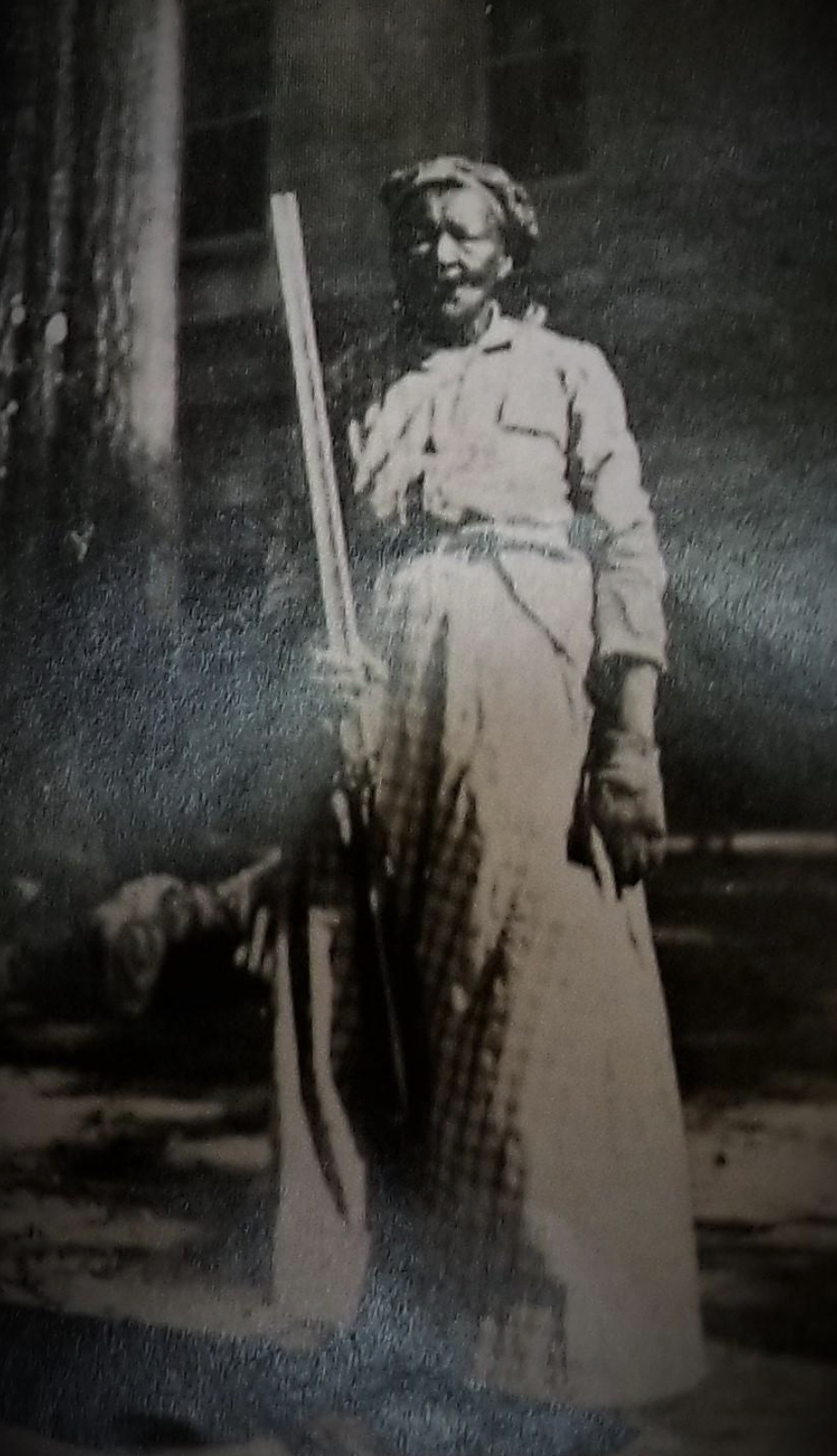
“Aunt Nancy Juice Pipe” was such a landmark in downtown Jackson that there was a postcard made with her image on it. It is reproduced in the 1981 book Jackson the Way We Were: Old Postcard Views from the Collections of Forrest L. Cooper and Donald F. Garrett, with text by Carl McIntire. The picture shows her in a formidable stance with a pipe in her mouth, sun glinting off high cheekbones, gloved hands, the right holding a double-barrel shotgun, with a glimpse of the Old Capitol building in the background.
Mrs. Hill lived a few blocks south of the Capitol at 720 Court Street where it ended at Commerce Street on the floodwaters of the Pearl River in those days. This is where Entergy is located now.
Around 1890, Mrs. Hill was allowed to build a house along the A. and V. railroad spur track that ran to the Standard Oil tanks at Court and Commerce Streets because Standard Oil had taken her property when they built their supply facility in her neighborhood in 1889. She built her own shanty from whatever material she could find – sheet iron, galvanized roofing, lumber scraps, skins, and flattened tin cans, and she lived in that house until it was destroyed by fire in 1926, when she was about 80 years old. After the fire, friends raised the money to build a new cabin for her on the same spot, with the permission of the Illinois Central that had taken over the A. and V. railroad.
In March 1929, on her deathbed dying of pneumonia, Mrs. Hill asked that she be buried “in the white folks’ cemetery.” She apparently meant Greenwood Cemetery, because that is where she was buried. Dr. W. A. Hewitt, pastor of the First Baptist Church, conducted the ceremony. Wright and Ferguson funeral home led the procession. Pall bearers were prominent citizens: Mayor Walter A. Scott, R. E. Kennington, J. M. Hartfield, T. M. Hederman, Dr. Julius Crisler (who signed her death certificate), Isidore Dreyfus, Jake Baxter and R. H. Green.
On the day of the funeral, March 21, 1929, the Clarion-Ledger related that “she will be interred in Greenwood cemetery this afternoon, arrayed in a white robe, in a white coffin, with white pall bearers, white preachers and white undertakers officiating.” There is, unfortunately, no extant marker for the burial place of this remarkable woman.
Do You Have More Information to Share?
Our historical research is never truly finished. Whether you have insights into our antique rose collection or stories of ancestors who rest here, your contribution helps Mississippi’s past come to life.