Matilda O’Leary: An Irish Immigrant Who Helped Build Jackson
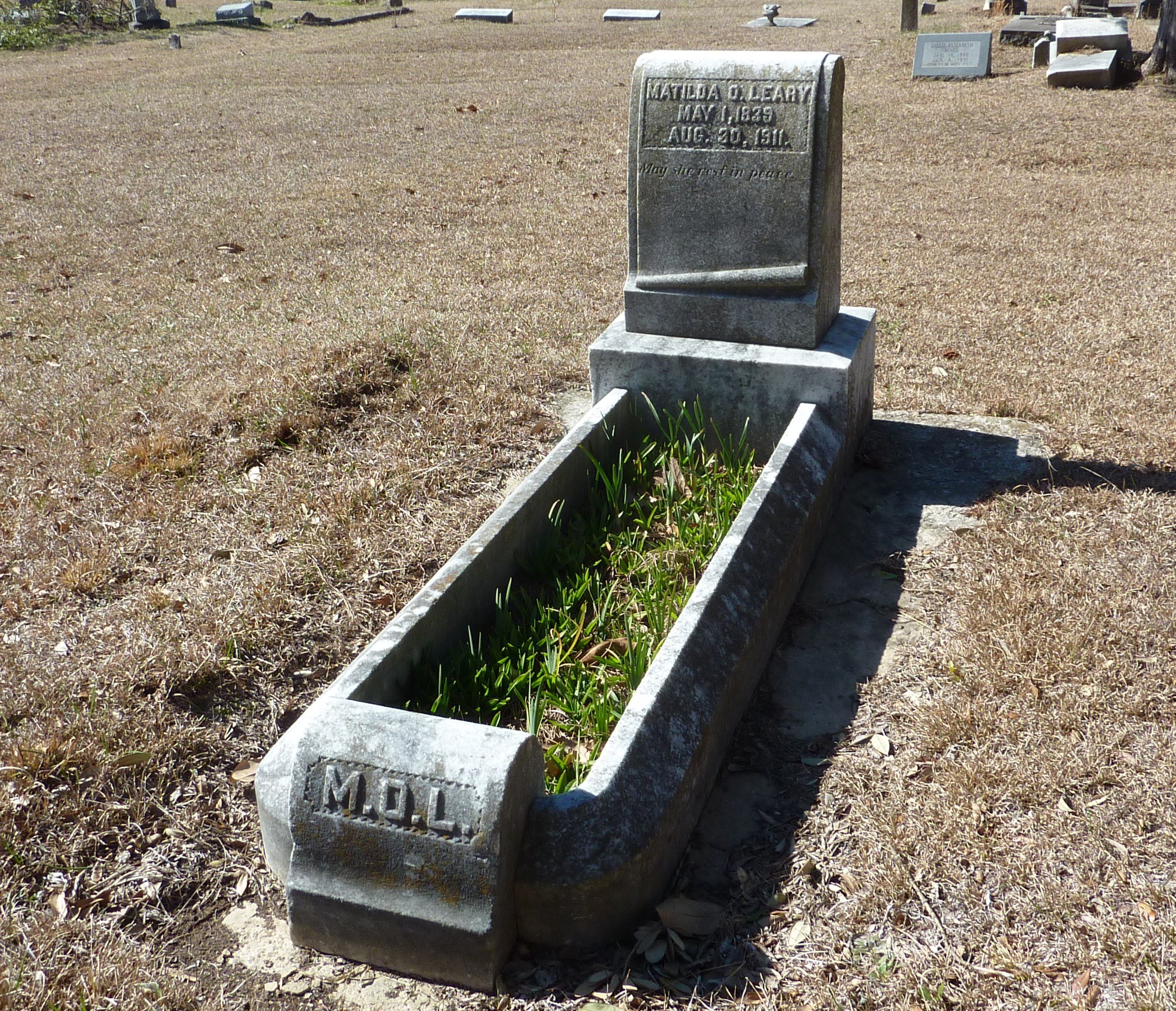
Image taken by Greenwood Cemetery Board Member Linda Robertson on the Cemetery’s Find A Grave page
[Note: This article was compiled from the research and work done by Greenwood Cemetery Board Member Linda Robertson published on Mrs. O’Leary’s Find A Grave website and various newspapers articles.]
In the late nineteenth century, as Jackson rebuilt and expanded in the years after the Civil War, one of the city’s most successful real estate developers was an Irish immigrant widow who had already endured extraordinary loss. Matilda O’Leary’s life story is one of resilience, entrepreneurship, and civic contribution. By the time of her death in 1911, she had become one of Jackson’s most prominent property owners, and her obituary described her as “a woman of exceptional business sagacity.”
Follow us on Facebook and Instagram
Matilda was born on 1 May 1839 in Londonderry, County Londonderry, Northern Ireland. As a young woman she left Ireland for Liverpool, England, where she found employment with the Edwards family. While working there she met William Edwards, the son of the household. The two married in Liverpool despite what family tradition suggests may have been objections from the Edwards family. A relic of that earlier life—a large ornate gold pocket watch that belonged to William—remains today in the possession of a descendant. Like many Irish families seeking opportunity in the aftermath of the Great Famine and the upheavals of the mid-nineteenth century, Matilda and William decided to emigrate to the United States. In 1865, shortly after the end of the American Civil War, they sailed for America with their young daughter Sarah. Matilda was pregnant at the time. According to family history, tragedy struck during the journey: William Edwards died either during the voyage or shortly after their arrival. He was buried in Gardiner, Maine. Soon afterward Matilda gave birth to their son William.
True to the Public Trust Since 1823
From Pulitzer Prize winners to those who served from the War of 1812 through WWII, Greenwood is a chronicle of sacrifice and success. Help us fund the research, tours, and preservation efforts that bring this history to life. Join us in honoring the depth and complexity of the Mississippi story.
Now a widow with two small children, Matilda made her way south to Jackson, Mississippi. In January 1867 she married Patrick O’Leary. The couple built a family together and eventually had four additional children—three daughters and a son. Their life together, however, was also cut short. Patrick O’Leary died in 1875, leaving Matilda widowed for the second time at the age of thirty-six and responsible for six children.
Patrick had been one of Jackson’s larger property owners, and his death could easily have ended the family’s fortunes. Instead, Matilda took control of the family’s business interests and expanded them. A red-haired Irish Catholic with a reputation for sharp judgment and determination, she proved herself an able businesswoman during a period when women rarely controlled major commercial enterprises.
Over the following decades she developed significant real estate in Jackson. Much of her work centered on the area surrounding the railroad depot on Capitol Street, a key commercial corridor in the growing city. She developed much of the north side of the 200 block of Capitol Street and additional property along North West Street. Among the structures she built was the building that housed the first location of McRae’s department store, which would later become one of Mississippi’s best-known retail institutions.
Matilda also operated a commercial office building in West Jackson known as the O’Leary Building, which served as headquarters for numerous local businesses. In addition to her commercial developments, she maintained a large residence on Capitol Street. That house no longer stands today, but the location lies near what is now the statewide headquarters for cooperatives—an area that continues to reflect the commercial energy that characterized the district during Matilda’s lifetime.
Her success placed her among the most substantial property owners in Jackson at the turn of the twentieth century. When she died on 30 August 1911 in Jackson at the age of seventy-two, the value of her estate was estimated at approximately $100,000, an enormous sum at the time. In modern terms, that amount represents roughly $3.4 million today, illustrating the scale of the wealth she had accumulated through decades of real estate development.
Matilda’s death drew considerable attention in the city she had helped shape. Obituaries appeared in both of Jackson’s major newspapers of the era, the Jackson Daily News and the Clarion-Ledger. The Clarion-Ledger obituary appeared on the newspaper’s front page, a testament to the prominence she had achieved. The paper praised her as a woman of remarkable business ability—high praise in an era when such achievements by women were rarely acknowledged so publicly.
Her obituary also noted her contributions to the building fund of St. Peter’s Catholic Church, reflecting the role she played in supporting Jackson’s Catholic community. Her life represented the broader story of Irish immigrants who helped shape Mississippi’s cities during the late nineteenth century.
Following her death, the distribution of her property was not without tension. Reports indicate that disagreements emerged among her children regarding the estate, particularly between her son from her first marriage, William Edwards, and the children from her marriage to Patrick O’Leary. Such disputes were not uncommon when large blended families inherited valuable property.
Matilda O’Leary was laid to rest in Greenwood Cemetery in Jackson, Section 5, Lot 44. Her daughter Maggie is buried beside her. Patrick O’Leary is believed to be buried at Greenwood as well, though no surviving grave marker identifies his resting place. It is generally assumed that he lies beside Matilda in the family plot.
Today, more than a century after her death, Matilda O’Leary’s name is not widely remembered outside historical circles. Yet the cityscape of Jackson once bore the clear imprint of her work. Through determination, business acumen, and perseverance in the face of repeated personal tragedy, this Irish immigrant widow built a substantial real estate empire and played a quiet but meaningful role in the development of Jackson at a formative moment in its history.
Author’s Note: This article was written by the author with the assistance of AI tools. The author directed the research, structure, and interpretation of the material, and has edited and reviewed the final content for accuracy and clarity.
Do You Have More Information to Share?
Our historical research is never truly finished. Whether you have insights into our antique rose collection or stories of ancestors who rest here, your contribution helps Mississippi’s past come to life.