Reverend Marion Dunbar: From Blacksmith to Church Builder
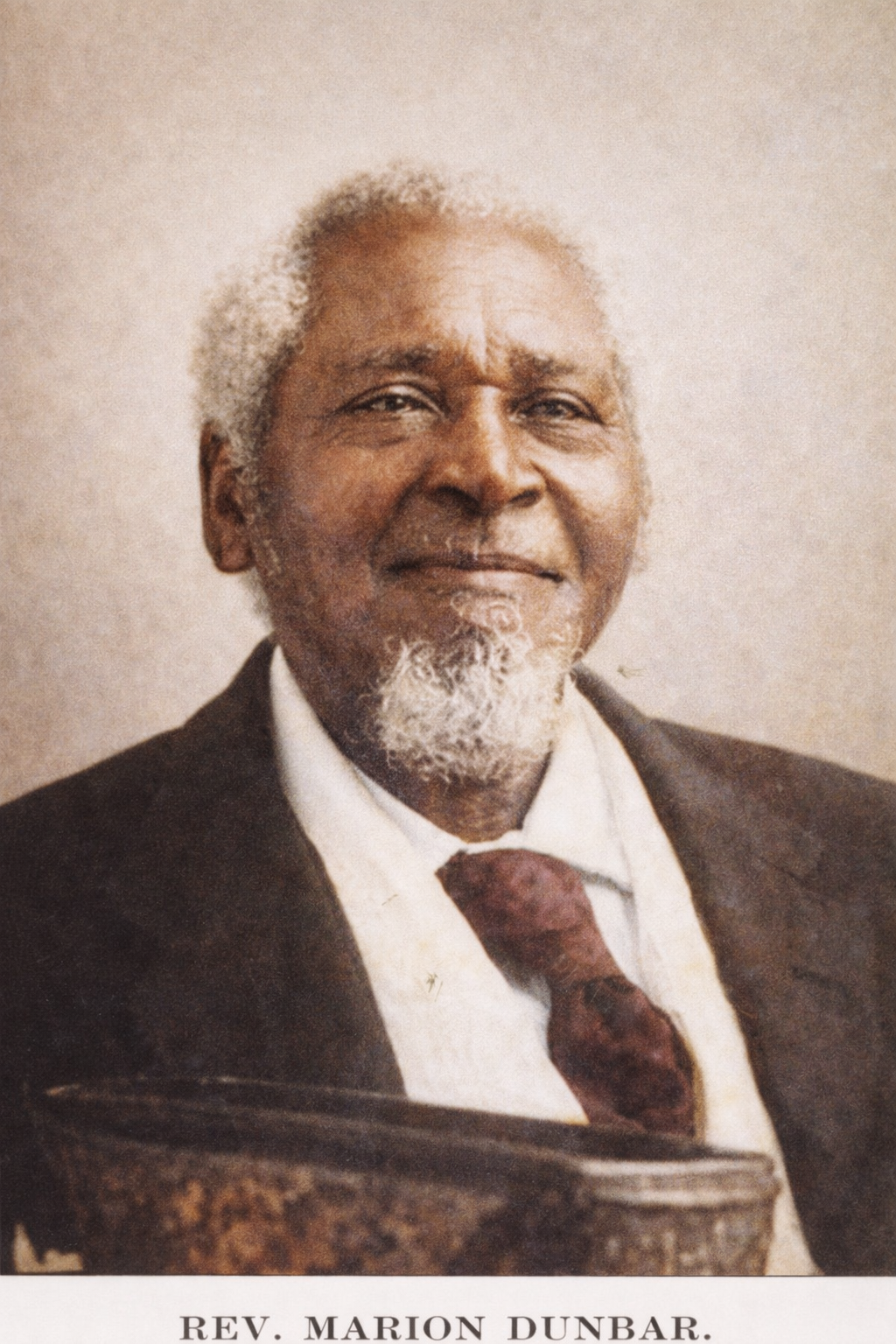
Photo taken from Rev. Dunbar's FindAGrave profile submitted by DeeDee Baldwin and enhanced with AI
[Note: This article was written by former Greenwood Cemetery Association President Peter Miazza from his book Voices Heard From the Grave published in 2018]
Marion Dunbar was born about 1810, in Georgia. The story of his youth has not survived him, only the fact that he learned the blacksmith’s trade.! As early as 1820, there were many white families in both Georgia and Mississippi with the Dunbar surname and some were large slave owners. One of the more heavily traveled migratory paths from Virginia and the Carolinas into Mississippi went through Georgia. In all probability, Marion Dunbar was swept along by this tide of migration. It is highly unlikely that he would have made the move from Georgia to Mississippi of his own volition if he had been a free black. However he made the trek, Marion Dunbar, at the age of eighteen or earlier, was found living in Jackson. His obituary reported that he had been born in 1812, and had arrived in Jackson in 1833. If these dates are indeed correct, then it is even more likely that he was brought to Jackson and did not come on his own.
The life of Marion Dunbar is closely intertwined with the history of the First Baptist Church of Jackson. In the early 1830’s, a Baptist minister by the name of Lewis B. Holloway and his wife arrived in Jackson from South Carolina.
Among the few Baptists Reverend Holloway found in Jackson was the wife of Governor Hiram G. Runnels. Undaunted by the paucity of Baptists, he began to preach in the State House located on the northeast corner of Capitol and President Streets. He shared this venue with other ministers of the Gospel. A Baptist church was finally organized about 1838. Fund raising began to build a house of worship and continued for several years as the congregation grew very slowly. Only a third of the congregation was white while the rest were slaves of the white communicants. The Legislature had set aside Square 13 North bounded by West, Yazoo, Congress, and Mississippi Streets to be sold to congregations for their church buildings. The Baptist group bought the southwest corner for $50.00 and construction began about 1843. One of the early converts and among the first to be baptized in the Pearl River was Mrs. Minerva Lea, the wife of Pryor Lea a native of Knox County, Tennessee and a wealthy slave owner. He had a very storied past having served in the Tennessee Legislature, fought in the Creek Indian War under Andrew Jackson, and served in the 20th and 21st U. S. Congresses before moving to Jackson in 1836.
Unfortunately, Mrs. Lea died sometime after the birth of her fifth child Pryor, Jr. about 1839. This event caused the widower to reevaluate his life. He entered into conversations with his slaves regarding religion and was eventually converted and baptized by Reverend Holloway.
Mr. Lea now took an active interest in the construction of the church and put his slaves to work making the bricks that were needed. By 1847, the church was completed. During this period Marion Dunbar was attending services and was also converted and baptized in the Pearl River by Reverend Holloway. Upon completion of the church and before yielding to the lure of the Republic of Texas, Pryor Lea used his influence to have the basement set aside as a church for the black members. Brother George Hollomon, a Black preacher from Georgia served as the first minister. He was succeeded by Marion Dunbar who now became the minister although he had not been ordained. Because of this, the white minister performed the ordinances of Baptism and the Lord’s Supper. In accordance with state laws at that time, several responsible whites would have to be in attendance during the black services. One of these monitors was Mr. S. P. Baley who would later marry the widow of Confederate General Richard Griffith who was killed in the war.
Follow us on Facebook and Instagram
Marion continued to minister to his black congregation during the ante-bellum era. The turmoil and horror of the War Between the States disrupted everything in Jackson including worship services. The Baptist Church was used as a hospital by both sides during the four times Jackson was invaded. Its use as a hospital probably saved it from the same destruction visited upon other churches in Jackson by the Federal army.
With the war ended and with it slavery, Marion was now free to go to Vicksburg, and there be ordained as a Minister of the Gospel. He then went to Eldora, Louisiana for a few months before returning to his flock in Jackson. There he continued his calling until one day in 1867, the white congregation finally decided that the noise emanating from the basement was disturbing their worship. The Black congregation along with its fifes, drums, and singing the old Negro spiritual, “Free at Last! Free at last! Thank God Almighty! Free at Last!” were asked to find another place to worship. Thomas E. Helm, a wealthy businessman and member of the Presbyterian Church, offered a lot on the corner of Grayson (now Lamar) and Church Streets for a church. Fund raising began and Mr. Helm contributed generously. While they were waiting for their new church to be built, Angelo Miazza offered the use of his new hall on Capitol Street so the First Colored Baptist Church met there until the new building was finished.
In appreciation of the gift of Mr. Helm, the church was named the Mount Helm Baptist Church. In 1868, the Jackson Baptist Association was formed by a member of the American Baptist Free Mission Society. Reverend Dunbar was elected the moderator and held that position until 1888. He soon formed the W. W. Colley Missionary Society at the Mount Helm Church to support Colley’s missionary efforts in Africa. Colley was also influential in organizing the National Baptist Convention, USA. During this period the Missionary Baptist Association was organized and Dunbar served on the executive board.
True to the Public Trust Since 1823
From Pulitzer Prize winners to those who served from the War of 1812 through WWII, Greenwood is a chronicle of sacrifice and success. Help us fund the research, tours, and preservation efforts that bring this history to life. Join us in honoring the depth and complexity of the Mississippi story.
Do You Have More Information to Share?
Our historical research is never truly finished. Whether you have insights into our antique rose collection or stories of ancestors who rest here, your contribution helps Mississippi’s past come to life.
In 1883 the Natchez Seminary, which had been founded by the American Baptist Home Mission Society in 1877 in the old U. S. Marine Hospital, moved to Jackson. The school purchased Elsinore plantation on the northern outskirts of Jackson from Mississippi Supreme Court Justice J.A.P. Campbell for $5,000 as a location for the new campus. Unfortunately, the only habitable building was the plantation house which became the president’s home. While Founder’s Hall was being built as a dormitory and classrooms, the facilities of the Mount Helm Baptist Church were offered and accepted. Classes were held there from 1883 to 1885 when Founder’s Hall was completed. The college underwent several name changes; Jackson College, Jackson College for Negro Teachers, Jackson State College, and finally Jackson State University.! In 1904, the campus was moved to its present location and the old campus sold to Major Millsaps and given to the adjacent Millsaps College.
Prior to 1850, Marion Dunbar took a wife, Lydia. Their first and only known child, Martha Jane, was born in July of 1850. Following the war, the Dunbar’s family started to grow. Their daughter married a man who has only been identified by his surname Terry and by whom she had at least four children. Her first daughter Melissa was born in 1866, followed soon after by Virginia in October of 1867. A third daughter Laura was born in September, 1869, and finally a son Edward in August of 1874. On November 3, 1887, Reverend Dunbar officiated at the wedding of his granddaughter Melissa to Charles Brown. On February 20, 1889, Virginia was married by Reverend B. W. Harris in Rankin County to William Weakley. The 1900 census lists a nephew, Wallace Weakley, living with Edward Terry along with nephews Percy and Herbert Terry. Wallace was apparently Virginia’s son and Percy and Herbert the children of Laura, Virginia was living by herself in Hinds County with a new, but yet unnamed, baby daughter born in April, 1900. Dunbar’s daughter Martha Jane married again for in her father’s will she is listed as Martha Jane Brown.
Even though Marion Dunbar’s principal vocation revolved around his ministry, he continued to earn a living as a blacksmith. He was financially successful early after the conclusion of the war. He bought Lot 57 in West Jackson. The transaction was actually between William H. Allen and Henry Toles, both prominent, Jackson businessmen. The property was bought in trust for Marion Dunbar. One can only speculate on the reason for this arrangement but the postwar period was froth with uncertainty. It was a two acre lot surrounded by Clifton Street on the west and Lea on the south, (now Lynch Street) and joined on the north by the Church lot. Pascagoula Street has since been cut through and would have been the northern boundary. He built his home on this lot and continued to live there for the rest of his life. In his will he left his home to his wife and daughter jointly. When Henry Daniel made his map of Jackson in 1875, he designated Lot 57 as “Marion Dunbar.”
Reverend Dunbar continued to minister to his congregation. The name of the church was changed to the Mount Helm Missionary Baptist Church. Time finally took its toll and in 1888, Marion Dunbar retired. A grateful congregation voted to continue his salary for life. He was succeeded by Reverend Elbert B. Topp, who a few years later pulled out in a fiscal dispute and founded the Farish Street Baptist Church. On August 13, 1892, an apparently weakened man, he penned an “X” attesting his will. Death came to Reverend Marion Dunbar just a few weeks later on Saturday night, September 3rd. His funeral, held the next day on Sunday, was, up to that time, one of the most attended in Jackson. Many of the white clergy attended and eulogized him. His funeral closed with the hymn, “In the Sweet By and By.” His remains were then carried to Greenwood Cemetery where he was laid to rest. His tombstone bears the inscription:
REV. MARION
DUNBAR
EX MODERATOR
OF JMB ASSN
REV. D. W.
WILLIAMS MOD.
B. N.
MONROE V
MOD