Four Occupations, Two Husbands, One Determined Woman: Mary D’Ambrogio
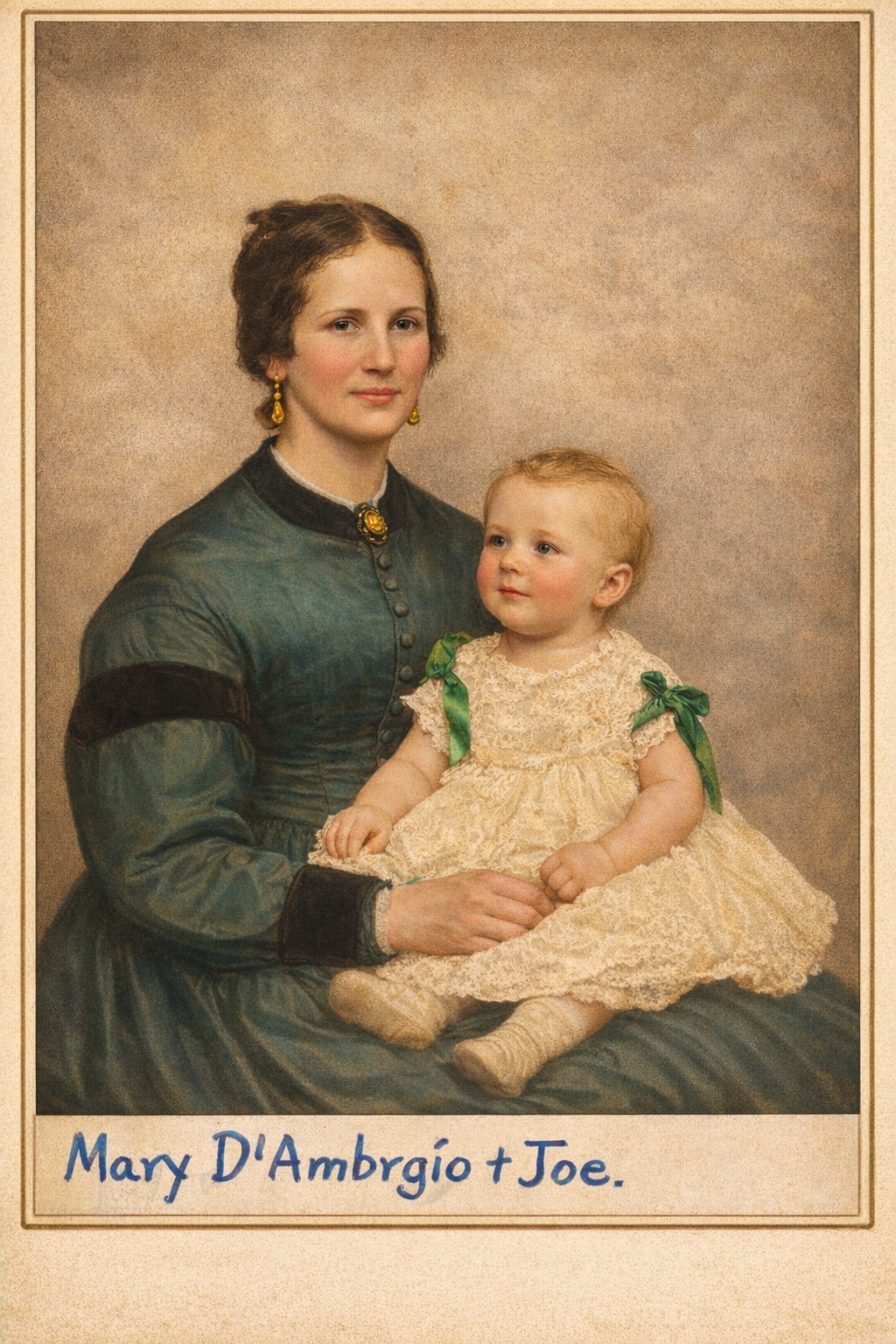
Mary D’Ambrogio with infant Joseph, photograph, ca. 1860s–1870s. Spengler Family Papers (Z/1776.000), Mississippi Department of Archives and History, Jackson, Mississippi. Image digitally restored and colorized using AI.
[Note: This article was taken from former Greenwood Cemetery Association president Peter Miazza’s book Voices Heard from the Grave.]
In 1858, Charles Frederick Worth founded the House of Worth in Paris, France. Soon, the gowns and dresses he created were the epitome of fashion. To be compared in any way to the famous House of Worth would be the highest compliment paid to a seamstress, but that is exactly what happened to Jackson’s Mary D’Ambrogio. Kate Markam Power wrote an article in an early edition of the Jackson Clarion-Ledger and entitled it, “Biography of Jackson’s Pioneer Business Woman Resembles Fiction Character.” In the article she described Mary simply, “What Worth meant to Paris in his day Mrs. D’Ambrogio meant to Jackson in hers.”
Follow us on Facebook and Instagram
Mary was born in Lyon, France in 1836. Lyon was situated in southeastern France and was surpassed in size only by Paris. It was the center of the thriving silk industry which was disrupted by two workers’ revolutions, one in 1831 and one in 1834. Her parents were Charles and Anne Ragasse, and her father was an architect. Perhaps the disruptions caused by the workers’ unrest influenced Charles’ decision to travel to America when Mary was only four years of age.
True to the Public Trust Since 1823
From Pulitzer Prize winners to those who served from the War of 1812 through WWII, Greenwood is a chronicle of sacrifice and success. Help us fund the research, tours, and preservation efforts that bring this history to life. Join us in honoring the depth and complexity of the Mississippi story.
They first settled in St. Charles, Missouri, where Mary’s younger brother died and was buried. After living in St. Charles for a few years, Mary’s father got the opportunity to work as an architect on the U.S. Customs House in New Orleans. Construction on that building began in 1848, which may be about the time the family made the move to New Orleans. Sometime later Charles contracted yellow fever while on a business trip to Central America and succumbed to the disease. While Mary was attending school at the Ursuline Convent, her mother, who had remarried, died during the severe cholera epidemic of 1849 when Mary was about fifteen. Her stepfather decided to send her back to France to live with her grandmother, but Mary had other ideas. She married her guardian, Joseph Fransioli. Joseph was a native of Switzerland whose home was Dalpe in Ticino Canton. Most of the inhabitants of Ticino are of Italian extraction. He arrived in New Orleans from Le Havre, France on November 25, 1836, on the sailing vessel MacLellan. Joseph was born about 1819, so he was seventeen years older than Mary. Joseph and Mary soon left New Orleans and traveled to Jackson, Mississippi. Mary Jane Overman was running a boarding house in Jackson and the Fransiolis boarded with her. In 1851, James Finnie Quinn, who was also a boarder there, sent for his daughter Eliza to join him. She had been living with relatives in Alton, Illinois situated on the Mississippi River. Eliza Quinn and Mary Fransioli became close friends. When Eliza accepted Angelo Miazza’s offer of marriage, the wedding took place in the Fransioli’s home. Three children blessed Joseph and Mary’s marriage: Mary Ellen in 1852, Josephine Eliza in 1855, and Charles A. in 1859.
Mary received a letter written in French and dated July 24, 1854, from her grandmother in Lyon, France. She thanked Mary for the “ten little gold coins.” She wrote that her husband had died three years earlier and that she was alone and had no income. Times, she wrote, were hard in Lyon; bread and milk were very expensive; there was no wine; and application was being made for her to enter a community. She signed, “Widow Dubessary.” Soon after their arrival in Jackson, Joseph started buying property in the town. In 1860 Joseph bought Benjamin Fearing’s store in the second block of South State Street. Unfortunately time was running out for Joseph and on Christmas Day of 1860 he signed his will with a very trembling hand and died in January. He divided his estate into equal parts for his wife and three children. He suggested to his wife that when the liquor license for his establishment expired she should have it renewed. Joseph was buried in Greenwood Cemetery. Employment opportunities for women at that time were quite limited and especially so for a widow with three young children. Fortunately for Mary, Joseph’s cousin, Joseph D’Ambrogio, had also come to Jackson from Switzerland. Soon Mary’s children gained a stepfather. Joseph D’Ambrogio picked up where his predecessor left off. He continued to operate the enterprise that Joseph Fransioli had begun. Soon the Civil War began, but at first it was a far distant event. Things changed significantly after the Battle of Corinth in 1862; casualties flooded into Jackson by the rail cars. Public buildings were taken over as hospitals. After several abortive attempts to take Vicksburg, General Grant moved his army across the Mississippi River landing in Bruinsburg south of Vicksburg. Although the capture of Vicksburg was his primary goal, Grant’s forces marched through Jackson on their way to Raymond and Champion Hill almost taking it. On May 15, 1863, Jackson fell to the Union Army for the first of four times. The citizens of Jackson were aghast at the atrocities inflicted on their beautiful little town of just over three thousand inhabitants. Warfare inflicted in such a manner on the women, children, and aged was devastating. Joseph was at his store trying to save it from destruction, never dreaming that his family was in danger. Union soldiers paraded through the streets around their home with frocks Mary had made for her daughters stuck on the tips of the soldiers’ bayonets. Finally their home on Capitol Street just across the street from the now existing Walthall Hotel was put to the torch. A Union lieutenant brought out Mary and her children. He stayed with her until he found a safe place for her. She remembered that his name was Lynch and tried to locate him after the war but was unsuccessful. Like the rest of the citizens of Jackson taking refuge sometimes in Greenwood Cemetery and sometimes in the Pearl River swamps, Joseph, Mary, and the children somehow managed to survive three more Federal occupations. Three years after the Civil War ended, Mary gave birth to little Joseph. Tragically, his father died soon after he was born. Once again Mary was a widow and this time she had four children for whom to provide. She put her sewing skills to work providing for her family. Soon she had to hire two seamstresses to help her. She was quite successful and, as previously mentioned, Kate Power wrote of her: “What Worth meant to Paris in his day Mrs. D’Ambrogio meant to Jackson in hers, and as the pressure of the post war period began to grow less cruel, her business and her reputation grew until there was none to rival her nearer than New Orleans; and the debutante and the bride whose trousseau was not made in her establishment felt that she had been cheated of the proudest part of her youthful due.” As the years passed Mary’s children grew to adulthood. Mary Ellen married John Charles Rietti, a Confederate veteran, on February 8, 1872. Josephine Eliza married Francis Conrad Spengler on October 26, 1876. Charles did not marry while his mother was still living. Each of the daughters had five children, most of whom Mary was able to welcome into this world. Finally Mary laid aside her needles and died in 1892. She was buried in Greenwood Cemetery between her two husbands. In later years their store on South State Street became her son Fransioli’s Rookery. He then moved his store to the location on Capitol Street where Mary’s home had once stood. In recent years the store was partially occupied by Lewis Wilson’s Men’s Wear and the name Fransioli’s Rookery was clearly visible high up on the west brick wall for many years. Mary and her two husbands, and her son Charles are buried in the older part of Greenwood Cemetery, Section 3 near Lamar Street. Her daughter Ellen is buried in Section 1, Lot 121 and Josephine is buried in Section 1, Lot 70.
Do You Have More Information to Share?
Our historical research is never truly finished. Whether you have insights into our antique rose collection or stories of ancestors who rest here, your contribution helps Mississippi’s past come to life.